
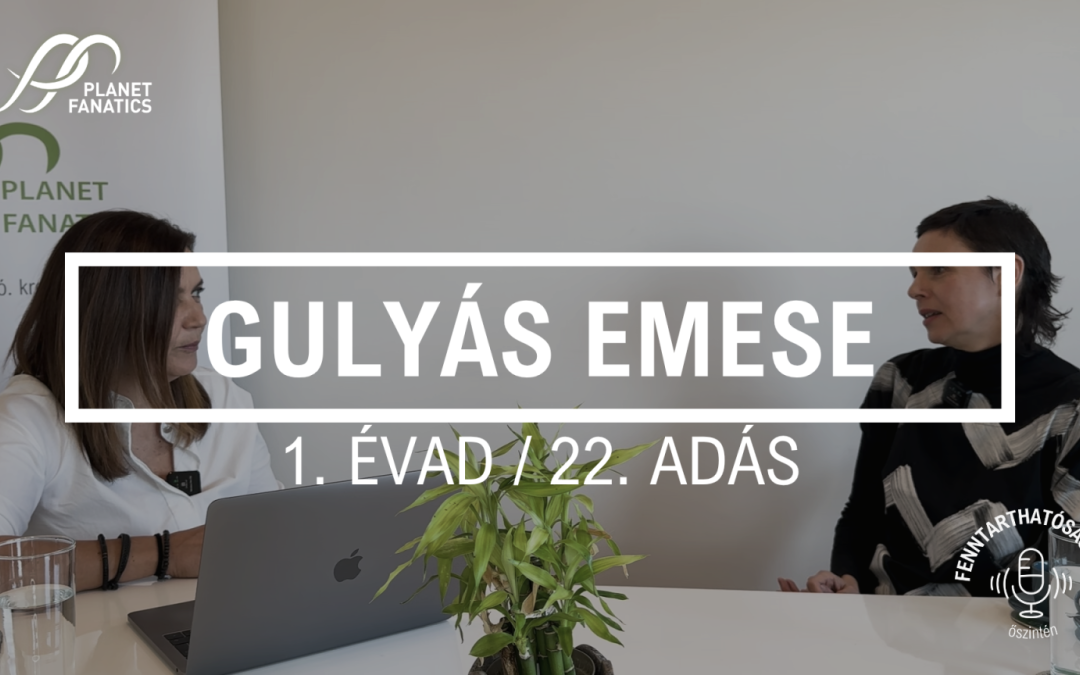
The guest on the latest episode of the Sustainability, Honestly podcast is Dr. Emese Gulyás, economist and sociologist, co-founder and president of the Association of Conscious Consumers (TVE), and ESG consultant, who has been guiding consumers toward more sustainable and ethical choices for over two decades.
The podcast recording can be watched on our YouTube channel and listened to on Spotify.
In this episode, we explored shifts in consumer behavior and dissected specific forms and tactics of greenwashing. Dr. Emese Gulyás and Katalin Szomolányi scrutinized the gap between consumer openness and actual behavior—pointing out that while we gladly opt for green alternatives, we still shy away from steps that require personal compromise. They examined the contradictory attitudes of Generation Z, where environmental education and an affinity for vintage fashion collide with budget flights and large carbon footprints. They also reviewed TVE’s core philosophy: putting the “your money is a vote” principle into practice.
The conversation broke down various greenwashing categories in detail:
-
Green crowding: the role of pseudo-alliances in misleading investors;
-
Green lighting: spotlighting a single minor detail (e.g., recyclable PET plastic material) to obscure the broader environmental impact;
-
Green shifting: deflecting responsibility onto consumers;
-
Green labeling: self-appointed eco-labels versus independent certifications;
-
Green rinsing: quietly abandoning and rewriting sustainability targets, alongside the risks of forward-looking marketing promises;
-
Green hushing: corporate silence around falling behind on stated goals.
Finally, they walked through TVE’s 11-point action list and articulated key expectations for Hungarian companies: honesty, cleaning up core business operations, and pursuing genuine innovations that reduce material consumption.
An episode exploring consumer psychology, exposing sophisticated greenwashing practices, and examining how to make sustainability truly measurable and credible in day-to-day operations.
SZK:
How has consumer environmental awareness evolved in recent years? Have we truly become more conscious, or has only the appearance improved?
GE:
Receptivity and openness toward green consumption are growing rapidly, yet actual behavior remains largely stagnant in many respects. Sustainable consumption rests on two fundamental pillars: reducing consumption and seeking greener alternatives. People’s mindset, however, has remained unchanged for a long time: we simply do not like giving anything up. We happily choose organic food or a hybrid/electric car, but switching to public transit or foregoing a trip is something we are far less willing to take on. The market mirrors this accurately: anything that offers an alternative grows, but anything that demands real sacrifice remains unpopular.
SZK:
Generation Z is often hailed as the greenest demographic. Are they genuinely more conscious, or does their behavior come with its own contradictions?
GE:
Generation Z is not a monolith, but they grew up immersed in environmental education and sustainability-focused textbooks—and many of their parents champion these values as well. In certain areas they are trailblazers, showing far greater openness to vintage and secondhand clothing, for example. At the same time, their behavior isn’t entirely consistent: for many of them, jetting off on a budget flight for a long weekend feels like second nature, even though the carbon footprint of such trips leaves their overall lifestyle balance deeply in the red.
SZK:
The well-known motto of the Association of Conscious Consumers is: “Every purchase is a vote.” To what extent has this resonated with Hungarian consumers in their daily lives?
GE:
This is a longstanding principle originating in human rights and political movements: if we are going to spend money anyway, let’s use it to decide which companies we support, striving to finance products with a lower environmental impact and a more positive social footprint. In our experience, many people can relate to this in everyday life, though based on widely differing priorities: for one person, supporting local farmers is decisive; for another, cruelty-free, animal-testing-free products come first. Often, they apply this values-driven approach only to a small fraction of their spending, holding companies accountable not as a whole, but strictly around the specific causes that matter most to them.

Dr. Emese Gulyás
Dr. Emese Gulyás is an economist and sociologist, co-founder and president of the Association of Conscious Consumers (TVE). She is an experienced civil society leader and certified ESG advisor in the investment field. Within the association, she oversees strategy, program innovation, and international partnerships. She has led numerous research projects to understand the drivers of sustainable, ethical consumption and conducted the first comprehensive market assessment estimating the market share of sustainable, ethical consumption in Hungary.
SZK:
Let’s talk about specific types of greenwashing! What do “green crowding,” “green lighting,” and “green shifting” actually entail?
GE:
Green crowding occurs when a company positions itself as sustainable not through its products or actual operations, but by virtue of “which club it belongs to.” A classic example is joining an industry coalition aimed at ending ocean plastic waste: it looks great to investors, yet is virtually invisible to the average consumer.
Green lighting, by contrast, happens directly at the product level: a single minor detail is spotlighted to obscure the full picture. A typical case is the “recyclable” label on PET bottles—the mere fact that the material is theoretically recyclable provides zero guarantee that it actually enters the processing system and gets recycled, all while diverting attention from excessive environmental impact.
Green shifting is when a company deflects responsibility onto consumers—such as slogans printed on tote bags like “let’s protect the environment together”—claiming it cannot become greener because shoppers aren’t on board, even though manufacturing processes could be overhauled far faster and more consistently from within.
SZK:
What about moving the goalposts (green rinsing), staying silent (green hushing), and making promises about the future?
GE:
With green rinsing, companies quickly alter or erase previously set targets as the deadline approaches—for instance, quietly scrubbing public commitments to fair wage adjustments. From TVE’s standpoint, the fundamental issue is using future goals as marketing collateral in the consumer market. Strategic roadmaps can certainly be presented to investors and partners, but businesses should not be pocketing a “green premium” from shoppers today based solely on promises set for tomorrow.
Green hushing, meanwhile, is the practice of simply omitting progress reports on a previously established target because performance is lagging, opting for corporate silence over transparency.
SZK:
In closing: what advice would you give Hungarian companies to pursue genuine sustainability instead of relying on marketing tricks?
GE:
The bedrock is honesty: communicate precisely what you are doing—no more, no less—and when seeking certification, rely on independent, third-party audited labels. Beyond that, the priority is to begin by greening core operations: assess where your largest environmental and social footprint occurs and intervene right there, rather than masking core issues with token gestures. Finally, there is an urgent need for product and service innovations that satisfy human needs without driving additional material consumption and environmental degradation—just as in mobility, where the user does not necessarily need a newer, larger vehicle, but rather safe, flexible, and reliable transit from A to B.
The podcast recording can be watched on our YouTube channel and listened to on Spotify.
We are taking a short break now, but we will be back with new episodes in January. Until then, we will be sharing the key takeaways from our first season—across environmental, social, and economic dimensions.
The Planet Fanatics’ Network Podcast
Welcome to our new series!
Sustainability, Honestly is the biweekly podcast of the Planet Fanatics’ Network. Our host, Katalin Szomolányi, sits down with renowned experts and decision‑makers to uncover the most pressing questions of our time.
What is the show about?
We don’t settle for surface‑level answers.
We look into what really drives markets and our planet—from global trends to shifting value systems and the technologies shaping our future.
Our aim is to provide an authentic picture of sustainability from both a business and a human perspective.
Where can you follow us?
Don’t miss the next episode!
Subscribe to our YouTube channel, follow us on Facebook and Spotify, and visit the Sustainable Headshot blog for background insights.
Join us on the journey toward the future!
If you missed it, you can access our previous episodes here:
Sustainability, Honestly with Péter Küllői (Episode 1)
Sustainability, Honestly with Péter Küllői (Episode 2)
Sustainability, Honestly with Éva Somorjai (Episode 3)
Sustainability, Honestly with Éva Somorjai (Episode 4)
Sustainability, Honestly with Zsolt Jamniczky (Episode 5)
Sustainability, Honestly with Zsolt Jamniczky (Episode 6)
Sustainability, Honestly with Sipos Katalin (Episode 7)
Sustainability, Honestly with Sipos Katalin (Episode 8)
Sustainability, Honestly with Dr. Ádám Guld (Episode 9)
Sustainability, Honestly with Dr. Ádám Guld (Episode 10)
Sustainability, Honestly with Dr. Andrea Czirók (Episode 11)
Sustainability, Honestly with Dr. Andrea Czirók (Episode 12)
Sustainability, Honestly with Viktor Lénárt (Episode 13)
Sustainability, Honestly with Viktor Lénárt (Episode 14)
Sustainability, Honestly with Miklós Mormer (Episode 15)
Sustainability, Honestly with Miklós Mormer (Episode 16)
Sustainability, Honestly with Rita Fontányi (Episode 17)
Sustainability, Honestly with Rita Fontányi (Episode 18)
Sustainability, Honestly with Ágnes Szalkai-Lőrincz (Episode 19)
Sustainability, Honestly with Ágnes Szalkai-Lőrincz (Episode 20)