
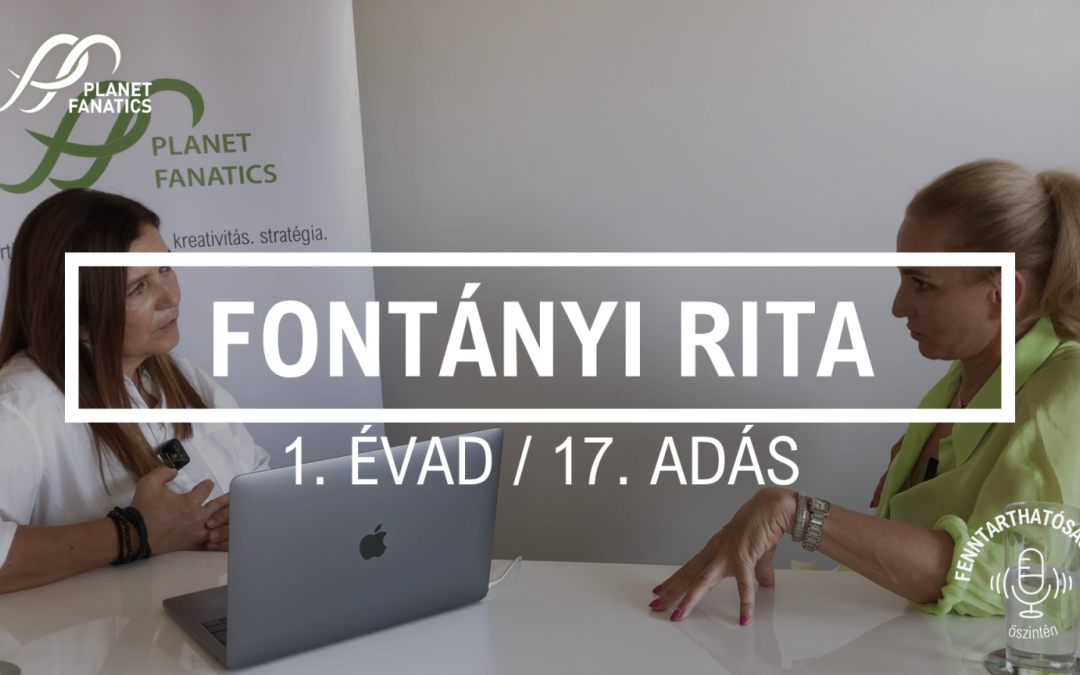
The latest episode of the Fenntarthatóságról őszintén podcast features Rita Fontányi, founder and CEO of P & B Aqua Zrt., who works day in, day out with her company to transform Hungary’s water management, modernize the drinking water supply system, and drive the digitalization of water utilities.
The podcast recording can be watched on our YouTube channel and listened to on Spotify.
In this episode, we explored the startling reality of Hungary’s water resources and the most pressing challenges of climate adaptation. Rita Fontányi and Katalin Szomolányi discussed why the notion of Hungary as a “water superpower” is a misconception, and why our underground aquifers are facing the most serious threats. They examined how droughts caused by climate change and falling river levels are putting the cooling of the Paks Nuclear Power Plant at risk, and why damming and river regulation are becoming unavoidable professional measures.
They also discussed the critical state of Hungary’s drinking water network, where, at the current pace of reconstruction, it would take nearly 500 years to replace the entire pipeline system. They addressed the challenges agriculture faces in adapting to climate change and the risks associated with illegal well drilling, as well as the enormous daily water demand of battery factories and industrial facilities.
They also highlighted why rebuilding a unified water management authority with a strong professional foundation—similar to the former Vituki—would be vital, instead of maintaining the current fragmented and bureaucratic system.
An episode about our country’s most precious resource, water; the consequences of long-delayed infrastructure investments; and why retaining water must finally become the absolute focus of our national strategy.
SZK
We often hear the stereotype that Hungary is a “water superpower.” Rita, how accurate is this in the age of climate change, and what is the actual state of Hungary’s water resources?
FR
We are not a water superpower at all; that is an outdated misconception. What truly makes us special is our thermal water, but we cannot use it for irrigation, nor can we drink it. Due to climate change, Hungary’s water resources have declined significantly over the past decades: riverbeds are deepening while water levels are steadily falling. Our underground aquifers in particular are facing a serious threat, even though they provide a significant share of our drinking water resources.
We have to accept that climate change and water scarcity have come knocking at our door. And because of the Carpathian Basin’s unique geographical situation, we are in an even more difficult position than the surrounding countries, because we failed to address adaptation in time.
SZK
You mentioned our drinking water resources. If our natural conditions are fundamentally favorable, what condition is the drinking water infrastructure in that delivers water to the population?
FR
Our natural conditions are fantastic. We truly have “God-given” drinking water, 95% of which comes from groundwater. However, our drinking water network is in a catastrophic condition. Of the approximately 80,000 kilometers of pipeline in Hungary, only 0.2–0.5% is modernized each year. This means that, at the current pace, it would take roughly 500 years to replace the entire network.
As a result, our network losses are enormous: approximately 22% of the water simply leaks out of the pipes. If we did not have this massive network loss, droughts and other emergencies causing water quantity problems would place a much smaller burden on water service providers.
SZK
How can digitalization and renewable energy help address this situation, and why are operating costs such a burden on utilities?
FR
Energy accounts for exactly 50% of the costs of water utility providers—the operation of wells, pumps and lifting stations comes at an enormous cost. Integrating renewable energy sources could directly reduce this huge energy burden.
Digitalization also has a key role to play in identifying and reducing network losses, and a HUF 50 billion funding program has just been announced for this purpose. However, it is very important that we do not simply apply ad hoc “Band-Aid solutions” to the system. Instead, modern measurement technologies, energy efficiency and renewable energy should be systematically incorporated into every new development.
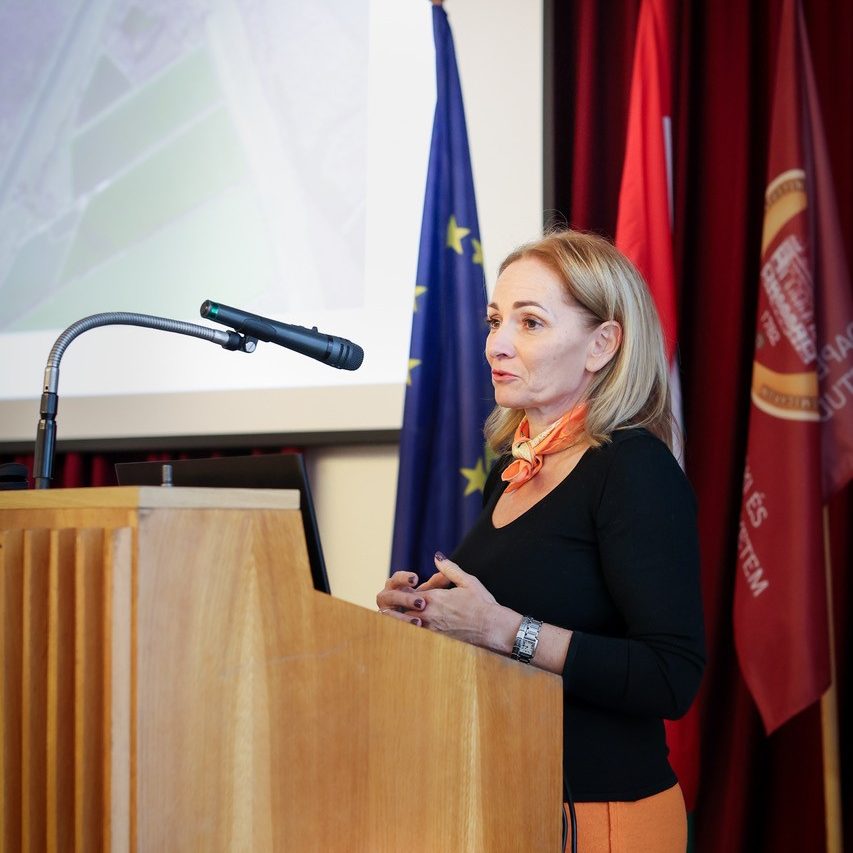
Rita Fontányi
Rita Fontányi is the founder and CEO of P&B Aqua Zrt. P&B Aqua is a research, development and engineering consultancy company whose mission is to modernize water management, including the modernization of drinking water supply systems, improving water balances, applying renewable energy sources in water management, and digitalizing water utilities. Our guest therefore does not view the challenges facing Hungary’s water resources from the outside; she works with them every day, from both a technical and an innovation perspective.
SZK
Agriculture is the other major water-consuming sector, and droughts are affecting it more severely year after year. Why is the adaptation of farmers progressing so slowly, and how is this connected to illegal well drilling?
FR
Unfortunately, droughts and drought-related damage are only going to get worse, yet we have come to a complete standstill when it comes to irrigation development because the system is overregulated, expensive, and has a very long payback period. Many farmers would rather take drought compensation, and as a result, they do not think in the long term. Those who do try to have a legal well drilled often get lost in the maze of bureaucracy and permitting procedures. As a result, illegal well drilling is flourishing, which means that we are continuously drilling into and putting our most valuable aquifers at risk.
While well-capitalized large farms are building their own water reservoirs, smaller farmers should be given simplified regulatory schemes that they can actually use with confidence.
SZK
Every summer, the low and rising temperatures of the Danube regularly raise concerns about cooling the Paks Nuclear Power Plant. Why is regulating the Danube and building impoundment structures the solution, rather than switching to other technologies?
FR
Operating the Paks reactor units with once-through cooling using water from the Danube is the cheapest and most economical solution, and the existing permits are based on this technology. Other closed-loop cooling systems, such as the construction of cooling towers, would involve an entirely different and extremely expensive technology.
The real solution is to regulate the Danube through impoundment. Although the issue has been considered a political taboo since the Bős–Nagymaros “Dinosaur” project, climate change has come knocking at our door, and as the bed of the Danube continues to deepen, water levels are falling dramatically.
If there were transverse barriers and weirs along the river—as there are in Slovakia and Austria—we could determine for ourselves how quickly the water leaves the country, thereby stabilizing water levels and ensuring safe cooling for the power plant.
SZK
Looking to the future, what are the most urgent tasks? Where should we begin taking action if Hungary is to successfully adapt to the water crisis?
FR
The most urgent task is not an engineering one but a structural one: we need to re-establish a strong, unified water management authority and professional team.
The current system is extremely fragmented. If a water utility company launches a project, constant reorganizations can mean that it has to deal with as many as six different ministries and authorities.
We are sorely lacking the professional foundation once provided by VITUKI, the Water Resources Research Centre, which was dissolved in 2012. Universities are trying to carry on its legacy, but under the current system, everyone ends up lobbying for their own particular field and region.
Without strong, centralized coordination, we cannot tackle drought, the deterioration of our drinking water network, and the declining water levels of our rivers at a systemic level.
The podcast recording can be watched on our YouTube channel and listened to on Spotify.
In two weeks, we’ll be speaking with Rita Fontányi (P&B Aqua Zrt.) again, this time about the state of our lakes.
The Planet Fanatics’ Network Podcast
Welcome to our new series!
Sustainability, Honestly is the biweekly podcast of the Planet Fanatics’ Network. Our host, Katalin Szomolányi, sits down with renowned experts and decision‑makers to uncover the most pressing questions of our time.
What is the show about?
We don’t settle for surface‑level answers.
We look into what really drives markets and our planet—from global trends to shifting value systems and the technologies shaping our future.
Our aim is to provide an authentic picture of sustainability from both a business and a human perspective.
Where can you follow us?
Don’t miss the next episode!
Subscribe to our YouTube channel, follow us on Facebook and Spotify, and visit the Sustainable Headshot blog for background insights.
Join us on the journey toward the future!
If you missed it, you can access our previous episodes here:
Sustainability, Honestly with Péter Küllői (Episode 1)
Sustainability, Honestly with Péter Küllői (Episode 2)
Sustainability, Honestly with Éva Somorjai (Episode 3)
Sustainability, Honestly with Éva Somorjai (Episode 4)
Sustainability, Honestly with Zsolt Jamniczky (Episode 5)
Sustainability, Honestly with Zsolt Jamniczky (Episode 6)
Sustainability, Honestly with Sipos Katalin (Episode 7)
Sustainability, Honestly with Sipos Katalin (Episode 8)
Sustainability, Honestly with Dr. Ádám Guld (Episode 9)
Sustainability, Honestly with Dr. Ádám Guld (Episode 10)
Sustainability, Honestly with Dr. Andrea Czirók (Episode 11)
Sustainability, Honestly with Dr. Andrea Czirók (Episode 12)
Sustainability, Honestly with Viktor Lénárt (Episode 13)
Sustainability, Honestly with Viktor Lénárt (Episode 14)