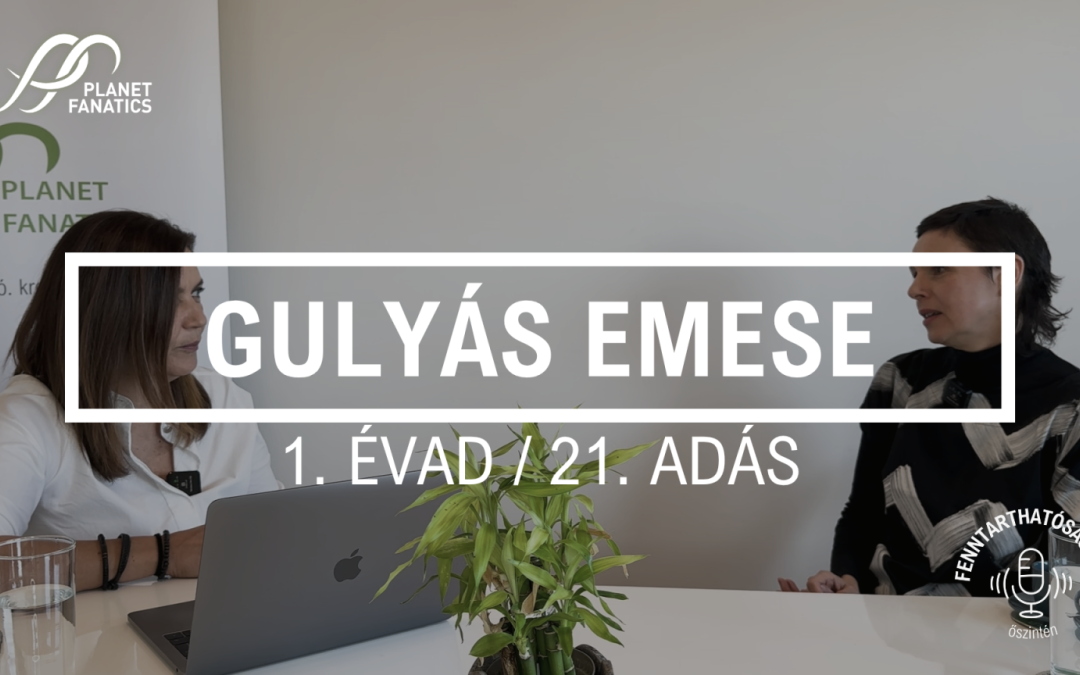
The guest of the latest episode of the Sustainability, Honestly podcast is Dr. Emese Gulyás, economist, sociologist, and ESG advisor, who is the co-founder and president of the Association of Conscious Consumers (TVE). For over two decades, she has been empowering consumers to make more sustainable and ethical choices.
The podcast recording can be watched on our YouTube channel and listened to on Spotify.
In this episode, we explored the phenomenon of greenwashing and its regulatory landscape. Dr. Emese Gulyás and Katalin Szomolányi discussed why green communication noise has become an urgent economic and consumer protection issue. They examined why a gap emerges between eco-conscious intentions and actual purchases—addressing social pressure, infrastructure shortcomings, and financial factors—as well as how greenwashing holds back genuinely innovative green companies.
They unpacked in detail the EU’s EMPCO Directive, which came into force on September 27, and its blacklist: why the use of generic, unsubstantiated slogans such as “eco,” “green,” or “sustainable” is now banned, why self-made “green badges” will no longer be accepted, and why comical, irrelevant claims like vegan plastic combs or gluten-free water are being phased out. They also delved into the stalled Green Claims Directive—from the pitfalls of supply-chain-wide life cycle assessments to the EU’s simplification and deregulation efforts—and why the directive is likely to fall by the wayside. Finally, they outlined what responsible businesses can do to maintain compliance and credibility: why precise, substantiated communication, third-party certification schemes, and clearly separating corporate operations from specific product features are all essential.
An episode about the fight against greenwashing, updated EU consumer protection rules, and how companies can remain authentic in shaping a more transparent and ethical market.
SZK
How did sustainability turn into a marketing tool, and why has greenwashing become so widespread in the market?
EG
The main driving force behind this is money and growth opportunities: companies see market potential in presenting themselves as green, as it enables them to develop, expand, and break into new niche markets. Although green communication hasn’t yet become the dominant market mainstream, growing consumer demand and an evolving EU regulatory framework are collectively nudging market players in this direction. Companies don’t want to fall behind their competitors, so standard competitive pressure also drives them to capitalize on this favorable market sentiment.
SZK
Research shows that most shoppers intend to follow eco-friendly principles, yet very few actually choose sustainable products at the checkout. What lies behind this so-called “intention-action gap”?
EG
While surveys indicate that over 80% of consumers consider environmental awareness important, this intention rarely translates into actual spending at the checkout counter. Consumer decision-making is exceptionally complex and shaped by numerous factors beyond mere intention: personal financial means, individual capabilities, as well as community and social pressures. Furthermore, infrastructure shortcomings—such as the lack of adequate EV charging stations or accessible green alternatives—also hold shoppers back. This gap is further widened by misleading green claims: the overwhelming communication noise and past disappointments foster doubt and confusion among consumers.
SZK
How do you define greenwashing at the Association of Conscious Consumers, and why does this phenomenon put genuinely committed businesses at such a huge disadvantage?
EG
At the Association of Conscious Consumers, we define greenwashing not only as completely false or vague claims, but also as the omission of key information vital to making an informed decision. What’s more, this doesn’t just mislead consumers—it misleads investors and young professionals choosing their employers as well. One of the most damaging consequences of greenwashing is that it actively stifles green innovation. If a genuinely committed company invests substantial capital into reducing its environmental footprint, yet finds itself competing against a rival that cut corners on that investment while making the exact same claims, it creates negative feedback and devalues real, substantive progress.

Dr. Emese Gulyás
Dr. Emese Gulyás is an economist and sociologist, co-founder and president of the Association of Conscious Consumers (TVE). She is an experienced civil society leader and certified ESG advisor in the investment field. Within the association, she oversees strategy, program innovation, and international partnerships. She has led numerous research projects to understand the drivers of sustainable, ethical consumption and conducted the first comprehensive market assessment estimating the market share of sustainable, ethical consumption in Hungary.
SZK
In September 2024, the EU’s new consumer protection directive, EMPCO, entered into force. What specific claims and practices were blacklisted under this directive?
EG
EMPCO is a so-called “blacklist-based” regulation that explicitly names prohibited or deceptive practices. Generic, unsubstantiated terms like “eco,” “green,” or “sustainable” are completely banned. Self-awarded, unverified green badges and logos created by companies themselves are also forbidden from now on; only independent, third-party audited certifications may be displayed. Irrelevant claims have likewise been outlawed—such as a plastic “vegan comb” or “gluten-free water”—along with unsubstantiated promises regarding product lifespan and repairability. If a company makes a claim, it must have rigorous, documented proof on file.
SZK
Even though EMPCO has entered into force, the other key pillar of the regulatory framework—the preventive Green Claims Directive—has stalled. Why are EU policymakers and industry stakeholders blocking it?
EG
The Green Claims Directive would have required green claims to be pre-verified and substantiated before publication. However, industry representatives argued that conducting life-cycle assessments across the entire supply chain is impractical, as gathering complete data from complex supply networks is virtually impossible. They also feared heavy administrative burdens and prolonged time-to-market for products. Furthermore, this pushback aligned with the EU’s broader drive toward red-tape reduction and deregulation. Unfortunately, this legal uncertainty and the potential demise of the directive also dampen the drive for innovation among responsible corporations.
SZK
In closing, what advice would you give to responsible companies: how can they communicate credibly and lawfully without coming under suspicion of greenwashing?
EG
The most important rule of thumb: communicate only as much as the company actually does! The safest and most effective approach is to rely on independent certification schemes, such as the EU Ecolabel, the Hungarian Environmentally Friendly Product certification, or the German Blue Angel (Blauer Engel) label. Additionally, companies must clearly separate corporate operational claims from specific product characteristics. Even an exemplary factory operating entirely on renewable energy can manufacture a high-impact, polluting product, so packaging and marketing must feature only precise, substantiated information regarding the product’s actual environmental performance.
The podcast recording can be watched on our YouTube channel and listened to on Spotify.
In two weeks, we will continue the conversation with Dr. Emese Gulyás, co-founder and president of the Association of Conscious Consumers.
The Planet Fanatics’ Network Podcast
Welcome to our new series!
Sustainability, Honestly is the biweekly podcast of the Planet Fanatics’ Network. Our host, Katalin Szomolányi, sits down with renowned experts and decision‑makers to uncover the most pressing questions of our time.
What is the show about?
We don’t settle for surface‑level answers.
We look into what really drives markets and our planet—from global trends to shifting value systems and the technologies shaping our future.
Our aim is to provide an authentic picture of sustainability from both a business and a human perspective.
Where can you follow us?
Don’t miss the next episode!
Subscribe to our YouTube channel, follow us on Facebook and Spotify, and visit the Sustainable Headshot blog for background insights.
Join us on the journey toward the future!
If you missed it, you can access our previous episodes here:
Sustainability, Honestly with Péter Küllői (Episode 1)
Sustainability, Honestly with Péter Küllői (Episode 2)
Sustainability, Honestly with Éva Somorjai (Episode 3)
Sustainability, Honestly with Éva Somorjai (Episode 4)
Sustainability, Honestly with Zsolt Jamniczky (Episode 5)
Sustainability, Honestly with Zsolt Jamniczky (Episode 6)
Sustainability, Honestly with Sipos Katalin (Episode 7)
Sustainability, Honestly with Sipos Katalin (Episode 8)
Sustainability, Honestly with Dr. Ádám Guld (Episode 9)
Sustainability, Honestly with Dr. Ádám Guld (Episode 10)
Sustainability, Honestly with Dr. Andrea Czirók (Episode 11)
Sustainability, Honestly with Dr. Andrea Czirók (Episode 12)
Sustainability, Honestly with Viktor Lénárt (Episode 13)
Sustainability, Honestly with Viktor Lénárt (Episode 14)
Sustainability, Honestly with Miklós Mormer (Episode 15)
Sustainability, Honestly with Miklós Mormer (Episode 16)
Sustainability, Honestly with Rita Fontányi (Episode 17)
Sustainability, Honestly with Rita Fontányi (Episode 18)
Sustainability, Honestly with Ágnes Szalkai-Lőrincz (Episode 19)
Sustainability, Honestly with Ágnes Szalkai-Lőrincz (Episode 20)