
On July 3, 2026, the European Commission adopted Commission Delegated Regulation (EU) 2026/1560 and Commission Delegated Regulation (EU) 2026/1563, which set out the new simplified European Sustainability Reporting Standards (ESRS) and the voluntary reporting framework for entities no longer subject to mandatory reporting. The regulations were subsequently published and entered into force on September 21, 2026.
Background to the Changes
Under the CSRD framework, in-scope large undertakings and listed small and medium-sized enterprises were required to prepare sustainability reports in accordance with the European Sustainability Reporting Standards (ESRS) on a phased-in basis, starting from financial year 2024.
Alongside this, by July 2025 the Commission had prepared a recommendation for non-obliged companies: the VSME (Voluntary Sustainability Reporting Standard for SMEs). This voluntary sustainability reporting standard provided non-obliged SMEs with a simplified framework to disclose sustainability data. In 2026, in line with the new ESRS, this is replaced by the VS (Voluntary Standard) to cover non-obliged entities.
Many stakeholders called for reducing the administrative burden of sustainability reporting. Following proposals put forward in 2025 to ease the system and the achievement of political agreement, the Omnibus I package was adopted on February 24, 2026. The aim of Omnibus I is to streamline EU sustainability regulations and reduce administrative burdens. The Omnibus I directive significantly narrowed the scope of companies covered by the CSRD.
Under the new rules, sustainability reporting is mandatory only for companies employing more than 1,000 employees with net turnover exceeding €450 million. For non-EU parent undertakings, alternative thresholds apply: €200 million turnover generated by an EU subsidiary, or €450 million consolidated turnover within the EU.
As a result, a substantial majority—approximately 85%—of previously covered companies fall out of the CSRD’s scope.
In addition, the European Commission revised the ESRS standards; on July 3, 2026, the Voluntary Standard Delegated Act and the Revised ESRS Delegated Act were published. In-scope companies will be required to apply the revised ESRS starting from financial year 2027.
The Voluntary Standard (VS)
For companies that no longer fall under the scope of the CSRD, the Commission introduced a single, voluntary sustainability reporting standard, replacing the former VSME (Voluntary Sustainability Reporting Standard for non-listed SMEs), which targeted non-obliged small and medium-sized enterprises specifically. The Voluntary Standard offers a simpler framework for non-obliged entities to disclose sustainability information, facilitating improved access to finance and supporting the development of management practices. Member States aim to encourage widespread adoption of voluntary reporting among undertakings.
Applying the VS is voluntary, yet it can offer significant commercial advantages. Banks, investors, large corporate customers, and public procurement contracting authorities increasingly request sustainability metrics from suppliers and partners (although the VS does not overlap entirely with all such external requests). The VS provides a harmonised framework for presenting this information, allowing companies to reduce ad-hoc data requests and improve comparability.
Value Chain Cap
A key element of this regulatory framework is the “value chain cap”, designed to protect companies in the value chain with fewer than 1,000 employees from disproportionate or excessive requests for sustainability data by CSRD-obliged corporations for reporting purposes.
Companies with fewer than 1,000 employees have a statutory right to refuse data requests that exceed the value chain cap. Any data requested by obliged entities beyond this threshold must be flagged as exceeding mandatory obligations, and disclosure may be declined.
Enterprises with fewer than 10 employees benefit from further relief. Their mandatory data disclosures are even more limited—certain data points remain strictly voluntary, meaning they may decline to provide information that could otherwise be requested within the value chain cap from entities with more than 10 employees.
Modules and Data Points
Another feature that makes the VS easier to implement is its modular architecture. It is designed to ensure a proportionate burden, allowing companies to report on their chosen information in structured modules. Crucially, reporting must cover all data points within a selected module—enterprises may choose which modules to apply, but cannot cherry-pick individual data points.
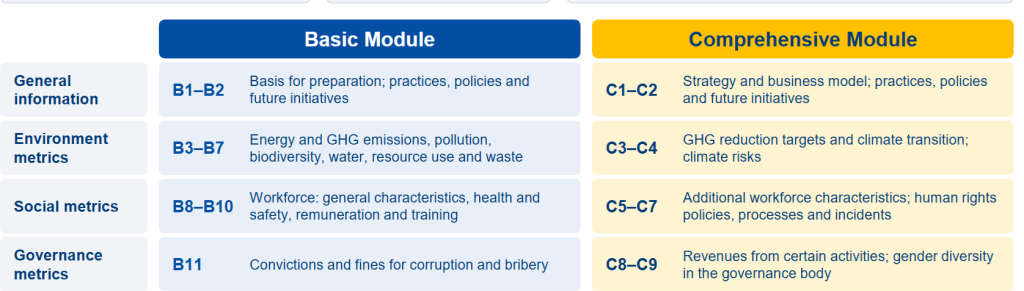
Basic and Comprehensive Modules of the VS Source: EFRAG
In line with the new ESRS standards, the VS also contains fewer data points than the former VSME. Several modules have been modified, and the Basic Module is substantially simplified, with multiple data points either removed or retained in a narrower scope. These include:
Changes in the Basic Module
Compared to the former VSME, several data points have been eliminated from the standard, while others have been simplified:
-
The disclosure of greenhouse gas (GHG) emissions intensity (GHG emissions normalized by net revenue) has been discontinued.
-
The four land-use indicators, which were previously voluntary, have been removed.
-
For operational sites located in or near biodiversity-sensitive areas, reporting the number of sites and total land area is no longer required; naming the sensitive area in question is sufficient.
-
Data on the gender pay gap must only be reported if specifically required by EU or national legislation.
-
Training hours per employee no longer need to be broken down by gender.
-
In areas with high water stress, companies are required to report water consumed rather than water withdrawn.
Changes in the Comprehensive Module
In the Comprehensive Module, companies are no longer required to disclose whether they are excluded from the EU Paris-aligned Benchmarks (PAB). Additionally, one data point—employee turnover—has been shifted from the Basic Module into the Comprehensive Module.
Modular Architecture
The standard is structured around two modules: the Basic Module and the Comprehensive Module. The Basic Module forms the baseline of every disclosure, and the Comprehensive Module can only be implemented on top of it. This enables companies to start reporting in accordance with their own maturity level and scale up progressively. Alongside the Basic Module, companies may opt to disclose specific individual data points from the Comprehensive Module without having to adopt the entire module at once. Furthermore, for micro-enterprises with up to 10 employees, a substantial share of disclosures—such as energy, emissions, water, and waste metrics—has become optional.
A more detailed overview of these changes can be tracked on the EFRAG Knowledge Hub website, where interactive EFRAG materials support businesses with reporting and understanding the VS. While not all materials currently available for the VSME are yet published for the VS, the resource library is continuously expanding.