
Author:
How did we perceive ourselves and each other in 2025?
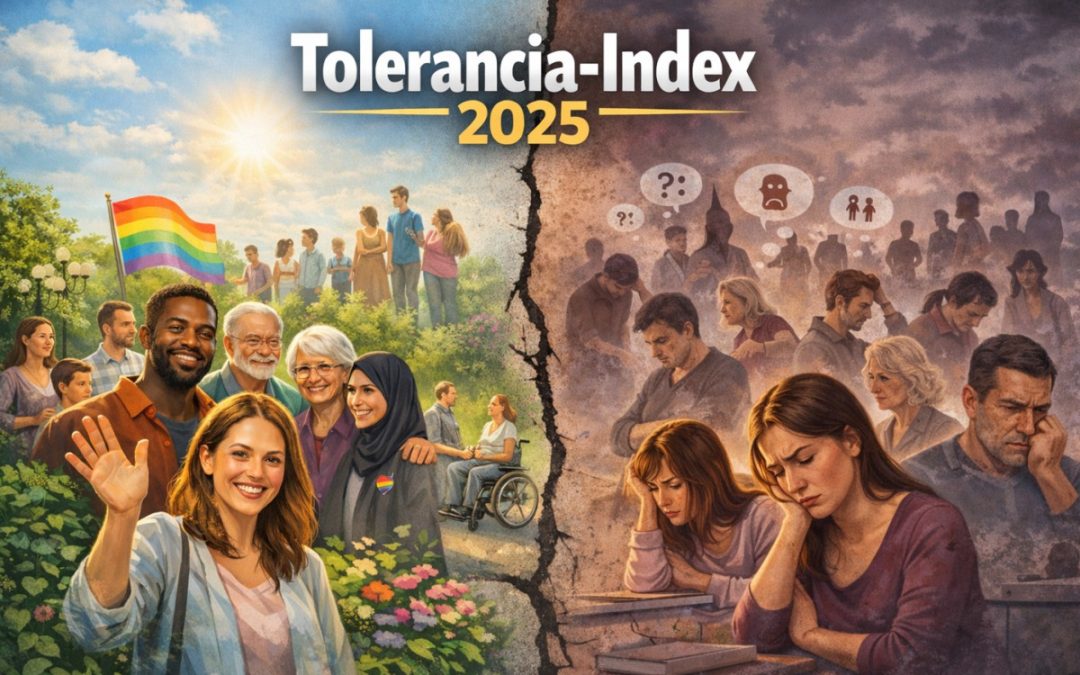
The latest Tolerance Index 2025 research reveals that while acceptance tends to dominate at the individual and immediate-community level, perceptions of Hungarian society as a whole remain significantly more pessimistic. Although most respondents describe themselves as open and supportive, tensions related to political views and systemic prejudices continue to create visible fault lines. In this article, we present the demographic background of the research, personal experiences, and perceptions of global tolerance.
In the summer of 2025, we launched a nationwide online survey to gain a comprehensive understanding of societal tolerance levels, attitudes toward diversity, and the evolution of social acceptance. A total of 1,003 people completed the anonymous questionnaire.
DEMOGRAPHICS
In the second half of 2025, our online survey was completed by 752 women (75%), 238 men (24%), 1 non‑binary respondent, and 12 individuals (1%) who chose not to disclose their gender.
In terms of age distribution:
- 1% were under 18,
- 85% were between 18–65,
- 14% were over 65.
Regarding place of residence:
- 47% live in Budapest,
- 17% in another county seat or major city,
- 21% in a Hungarian town,
- 12% in a village,
- 2% are Hungarian citizens living abroad.
Educational attainment:
- 1% completed only primary school,
- 1% vocational school,
- 7% technical secondary school,
- 11% grammar school,
- 22% college,
- 54% university,
- 3% hold a doctoral degree.
The “average respondent”
Based on the above data, there is a strong female overrepresentation, respondents tend to be highly educated, and a large proportion live in Budapest. All of this indicates that overall survey results were likely to show higher acceptance and stronger tolerance. This is further reinforced by workplace distribution.
- 27% work at a multinational corporation
- 6% at a large Hungarian company
- 8% in a civil organization
- 7% in a state institution
- Only 18% work in the SME sector
This means that “white‑collar” employees and those in the civil sector are overrepresented.
Therefore, it is important not only to examine the averages (Part I) but also to explore differences and weighted results across various respondent groups (Part II).
EXPERIENCES
In the first section, we assessed whether respondents had experienced discrimination or exclusion, and what their personal background was in relation to these experiences.
Minority affiliation
- 77% stated they do not belong to any minority group.
Among the remaining respondents: - Ethnic minority: 8%
- National/linguistic minority: 13%
- Religious minority: 18%
- LGBTQ+: 22%
- People with disabilities: 18%
- Foreign background: 16%
- Neurodivergent: 4%
- Women listed themselves as “other”: 2%
Self‑identification
When asked which traits best describe them personally:
- Family‑oriented: 68%
- Religious: 13%
- Committed to women’s rights: 51%
- Conservative: 17%
- Liberal: 53%
- Environmentally conscious: 64%
- Hungarian: 86%
- Ethnic minority: 1%
- Linguistic minority: 3%
- Disability: 5%
- LGBTQ+: 6%
- Young: 31%
- Elderly: 15%
- Other: 7%
The “other” category included political or ideological traits, personality characteristics, family status or background‑related attributes.
Experiences of negativity
- 80% reported having felt negative attitudes from others at some point.
- 10% said no.
- 10% did not remember.
One‑third of those who had such experiences could not identify the source.
Among those who could, the most common reasons were:
- Political views: 42%
- Being childfree: 17%
- Driving a car: 14%
- Dog ownership: 10%
- Cycling: 10%
- Personality traits (introversion, extroversion, etc.): 9%
- Family status: 8%
- Gender or age: 8%
- Physical appearance: 7%
Experiences of exclusion
- 54% experienced exclusion or discrimination.
Only 15% could not identify the reason.
Main reasons cited: - Gender discrimination: 22%
- Age discrimination: 18%
- Background/ethnicity: 9%
- Appearance: 9%
- Religion: 7%
(Gender-based discrimination is likely elevated due to the female-heavy respondent base.)
GLOBAL ACCEPTANCE VS. PERSONAL EXPERIENCE
When asked whether they agreed that “Globally, people generally accept those who are different from the majority,” only:
- 2% fully agreed
- 31% rather agreed
- 51% rather disagreed
- 13% fully disagreed
Perception of tolerance in Hungary
- Very low: 26%
- Low: 45%
- Medium: 26%
- High: 2%
Perception of tolerance in one’s direct environment
- Fully accepting: 15%
- Rather accepting: 74%
- Rather not: 9%
- Not at all: 1%
Perception of how accepting society is towards them personally
- Fully accepting: 19%
- Rather accepting: 57%
- Rather not: 16%
- Not at all: 5%
Groups most often subject to prejudice
Selected by respondents:
- Trans people: 80%
- Ethnic minorities: 74%
- Homosexual people: 74%
- Muslims: 72%
- Immigrants: 70%
- People with mental health issues: 61%
VISIBILITY
Respondents personally know someone who is:
- Another religion: 95%
- Ethnic minority: 89%
- LGBTQ+: 85%
- Disabled: 82%
- Immigrant: 77%
CHANGE 2020 VS. 2025
Personal tolerance levels
- Stayed the same: 56%
- Improved significantly: 5%
- Improved somewhat: 26%
- Declined: 11%
- Declined significantly: 2%
Positive change was most often linked to personal experiences or social events.
Negative change: political/public discourse, worsening living conditions, stress, overload.
Perception of societal tolerance
- Improved significantly: <1%
- Improved somewhat: 9%
- Unchanged: 25%
- Declined: 53%
- Declined significantly: 13%
Reasons mirrored personal assessments: political communication, economic difficulties, social media.
MEDIA CONSUMPTION
Given that the survey targeted internet users, high online media usage was expected:
- Online news portals: 78%
- Social media: 74%
- TV: 30%
- Radio: 20%
- Print: 6%
- Podcasts: 30%
- Thematic YouTube content: 42%
Most frequently mentioned channels:
- Telex: 34%
- Facebook: 30%
- YouTube: 18%
- 444: 16%
- Instagram: 14%
- RTL: 12%
- HVG: 11%
- ATV: 10%
- 24.hu: 9%
- Index: 7%
- Partizán: 6%
- TikTok: 5%
- Other portals: 5%
THE ACCEPTANCE BUBBLE
The first results of the Tolerance Index 2025 reflect a dual social reality. Respondents—typically highly educated urban residents—perceive their immediate micro‑environment (family, friends, workplace) as overwhelmingly accepting and tolerant. In stark contrast, they view Hungarian society as broadly intolerant, with tolerance levels having worsened significantly in the past five years.
Key findings
- Invisible barriers:
Political differences are the primary source of negative attitudes today, followed by gender- and age‑based discrimination. - Values and prejudices:
While there is strong consensus around core values such as supporting people with disabilities or respecting human dignity, notable prejudices remain—especially towards Roma people and immigrants—even among more open groups. - Pessimistic outlook:
Respondents attribute rising societal tensions mainly to political/public communication and worsening living conditions.
This first analysis shows that although individual attitudes may reflect openness, the lack of social dialogue and the deepening societal divide have left a strong imprint on the public mindset.
In Part II of the research, we will examine differences across respondent groups and explore deeper patterns of tolerance using weighted data.
Further information
If you are interested in the detailed analysis or the persona‑specific findings, please contact us at:
📧 mail@planetfanatics.hu