
Author:
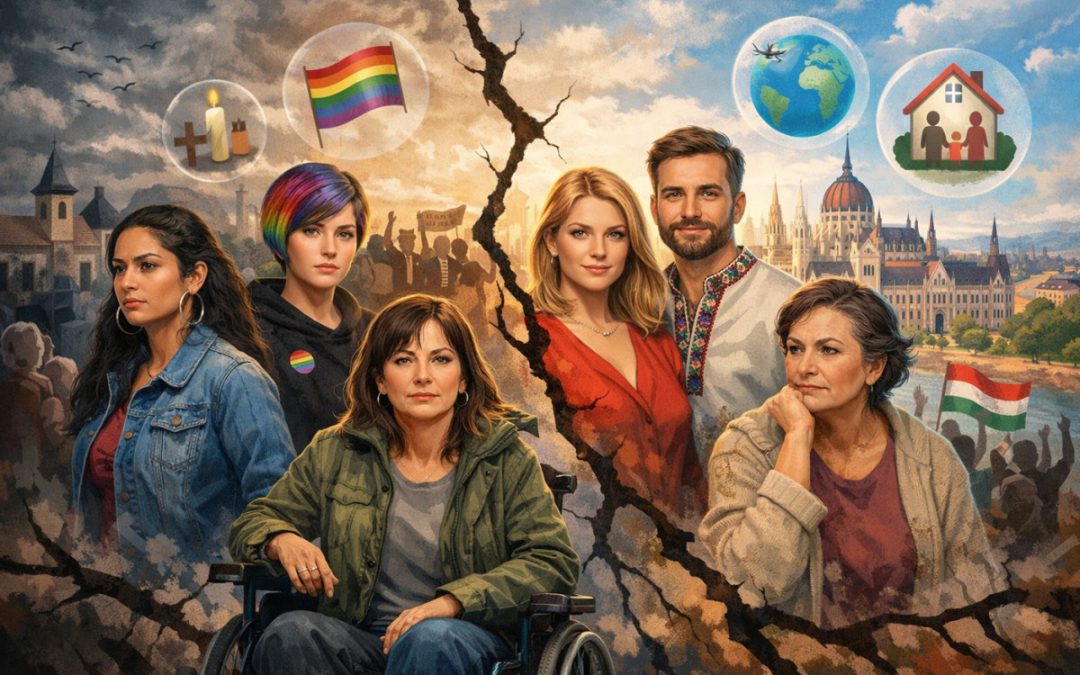
Based on the research data, we identified seven characteristic personas. Through their stories, we can better understand how the noise of national politics and the weight of the economic crisis manifest in everyday life.
On the Front Line: Eszter and Luca
Those who suffer exclusion because of fundamental parts of their identity are in the most difficult position.
Eszter – The Excluded Intellectual
Eszter, a university‑educated Roma woman in her thirties living in Budapest, could be a symbol of social mobility—yet she constantly hits invisible walls. She is the only persona whose group reported 100% experiencing negative attitudes, identifying ethnicity as the primary reason (75%).
Eszter has the darkest outlook: 65% of her group feels society is not accepting at all. For her, politics is not an abstract concept but a direct threat: 100% cite political and public communication as the main cause of declining tolerance.
Luca – The LGBTQ+ Youth
Luca, a young LGBTQ+ adult in her mid‑twenties living in a small town, finds her rural environment the greatest challenge. Although she openly and proudly embraces her identity (91% in her group selected this trait), the feeling of rejection is deepest here:
41% feel their immediate environment is not accepting at all.
Luca faces disadvantages not only due to her sexual orientation (50%) but also her political views (41%)—suggesting that in smaller towns the labels “liberal” and “LGBTQ” often merge into a single target for exclusion.
The Fighters and the Paradoxes: Katalin and Elena
Some must confront multiple layers of disadvantage, while others experience surprising forms of protection.
Katalin – The Colleague Living with a Disability
Katalin, a woman in her forties from a large city, represents the “realistic fighter.” Her story is also one of economic survival. Though she faces daily discrimination (89% have experienced negative attitudes), the worsening living conditions (61%) weigh most heavily on her perception of declining tolerance.
Katalin is active—many in her group are entrepreneurs or employees of SMEs—but stress and overload (56%) burden her nearly as much as prejudice.
Elena – The Cosmopolitan Expat
Elena, also in her forties, is a foreign‑born woman living in Budapest and embodies the research’s most striking paradox. While 100% of her group has experienced negative attitudes, 62% still feel Hungarian society is generally accepting of them.
How is this possible? Likely because Elena lives in the “Budapest bubble” and works in an international environment, which provides a protective shield. For her, the causes of exclusion are split equally between political opinions (44%) and foreign background (44%)—meaning she is often targeted not for being foreign, but for being a “liberal foreigner.”
The Power of Community: Sára and Tamás
These two personas illustrate how community belonging or successful assimilation can soften the experience of exclusion.
Sára – A Member of the Jewish Community
Sára, a 35‑year‑old woman from a religious minority, has faced discrimination due to her faith (56%), yet among minority groups she is the one who feels society is the most accepting of her. Her community and faith provide a strong identity that buffers external hostility.
She is socially highly sensitive, placing exceptional importance on supporting people with disabilities. However, her tolerance is selective: she remains sceptical about immigrants and is more cautious about interfaith marriages than other minority groups.
Tamás – The “Model Citizen”
Tamás, a man in his late forties from a large rural town and a member of a national minority, is perceived as a “model citizen” by the majority. He strongly identifies as Hungarian (90%), is family‑oriented, and his environment shows the highest acceptance rate (76% “rather yes”).
Although he also experiences negative attitudes, his strategy of blending in—adopting majority societal values—appears successful in everyday life.
The Anxiety of the Majority: Zsuzsanna
Zsuzsanna – Representative of the Majority Population
Finally, we have Zsuzsanna, a woman in her late fifties from a small town, representing those who “do not belong to any minority group.” One might assume she is fully protected—but the data says otherwise.
79% of the majority population have also felt negative attitudes toward them, most often due to political views (22%).
Zsuzsanna generally feels safe (60% find their environment accepting), yet political polarisation and economic insecurity (54%) make her feel that the world is deteriorating around her. Although she identifies as liberal, she exhibits the strongest hidden biases toward Roma people and immigrants.
A Portrait of a Fragmented Society
The combined stories of these seven personas paint a picture of a deeply divided Hungary, where tolerance is no longer merely a minority issue.
Politics as the Universal Enemy
Whether it is excluded Eszter, expat Elena, or majority Zsuzsanna, one point of total agreement emerges: political and public communication are seen as the greatest threat to social peace.
This insight cuts across all social groups.
Economic Anxiety and Scapegoating
The research shows that tolerance becomes a luxury in times of economic hardship. Katalin and Zsuzsanna’s stories illustrate how worsening living conditions directly correlate with impatience and social tension. Increasing stress amplifies insecurities and frustrations—often taken out on others.
The Strategy of Bubbles
Findings suggest that survival in today’s Hungary depends on the ability to create protective “bubbles.”
- Those who manage to build strong micro‑communities—like Sára within her religious community or Elena in the Budapest expat environment—remain relatively protected.
- Those who stand “in the open,” without such support—like Luca, the rural LGBTQ+ youth, or Eszter, the Roma intellectual—become lightning rods for societal tension.
Yet the most striking contradiction lies in self‑identification, which fundamentally challenges exclusionary narratives. Although ethnic minorities face the highest levels of discrimination, they identify as Hungarian at a higher rate (100%) than both the majority population (85%) and national minorities (90%).
Unexpected Bridges
- Commitment to women’s rights serves as a hidden bridge between the excluded ethnic minority group (75%), the liberal LGBTQ+ community (73%), and religious minorities (69%).
- Environmental consciousness also unites diverse groups—from the “cosmopolitan” foreigner (75%), to the more conservative national minority respondent (62%), and the safety‑seeking majority (66%).
Despite political and economic divides, the value systems and identities held by individuals—from Hungarian national identity to green thinking—form a more coherent fabric than public conflict narratives suggest.
Diversity as a Value
At Planet Fanatics’ Network, as a sustainability advisory firm, our mission is to help uncover the hidden barriers to effective collaboration within organisations. Through our employee workshops, we support teams in moving beyond instinctive reactions and truly embracing diversity as a value—one that also enhances organisational performance.
If you are interested in the detailed evaluation of the research, the persona‑specific study, or if you would like support in addressing and reducing unconscious biases within your organisation, please contact us at:
📧 mail@planetfanatics.hu