

The announced initiative aims to integrate climate-related risk management into European policies, infrastructure investments, and national planning, helping governments, businesses, and communities prepare for deteriorating environmental conditions.
Its urgency is increasingly underscored by climate-related disasters, which are generating ever-higher costs across Europe. According to Commission estimates, damages caused by climate change resulted in approximately €200 billion in economic losses between 2022 and 2025, averaging €50 billion annually. Further estimates indicate that adapting European infrastructure and economic activities to future climate conditions will require an annual investment of €70 billion. Investment priorities include protecting buildings, transport networks, water systems, agriculture, and other essential services from extreme weather.
According to the Commission, the return on investment—through avoided damages and recovery costs—could exceed ten times the initial outlay.
Climate change adaptation can also represent an economic opportunity for European businesses. The Commission forecasts that the global market for climate adaptation solutions could quadruple by 2050, reaching approximately €3.5 trillion. Technologies supporting cooling, water efficiency, flood protection, and infrastructure resilience stand to benefit from increased investment.
The Climate Resilience Act with Common Warming Scenarios
The central premise of the proposal is that climate risk management everywhere should stem from the same warming scenario and have clearly designated accountability. Today, this is not the case: Member States draft plans using divergent assumptions, varying paces, and differing scopes of coverage.
According to the Commission, adaptation in Europe is fragmented, incremental, and failing to keep pace with the accelerating rate of climate change.
The document’s starting assumption is that, under current global commitments, warming of approximately 2 °C by 2050 and approximately 3 °C by the end of the century is to be expected. Europe is the fastest-warming continent; here, an increase of 4–5 °C above pre-industrial levels could occur by 2100. The regulation’s preamble explicitly states that global warming will, at least temporarily, exceed the Paris Agreement’s 1.5 °C threshold—a projection that aligns with UNEP estimates.
The Commission outlines the current situation through three main factors:
-
Member States proceed from different assumptions. They employ divergent warming scenarios, varying assessment cycles, and disparate territorial coverage, rendering risks non-comparable.
-
Cross-border risks are difficult to manage. River basins, energy grids, supply chains, and financial systems do not stop at national borders.
-
Existing law is insufficient. The European Climate Law already mandates national adaptation strategies, and according to the Commission’s 2023 evaluation, while these largely exist, their implementation remains inadequate. Non-binding 2023 guidance provided only limited remedy.
The proposal also responds to calls from EU institutions: the European Parliament, the Council, the Committee of the Regions, and the European Court of Auditors have all urged a more unified approach. The European Court of Auditors’ 2024 report highlighted this concern under the premise that adaptation is failing to match ambitions.
The Five Building Blocks
Rather than prescribing specific policy measures, the regulation establishes a common framework built on five pillars. The objective is for the Union and all Member States to continuously enhance the resilience of social, economic, and ecological systems over the short, medium, and long term, particularly against risks to human life and health, the economy, infrastructure, and nature.
1. Common Reference Warming Trajectory
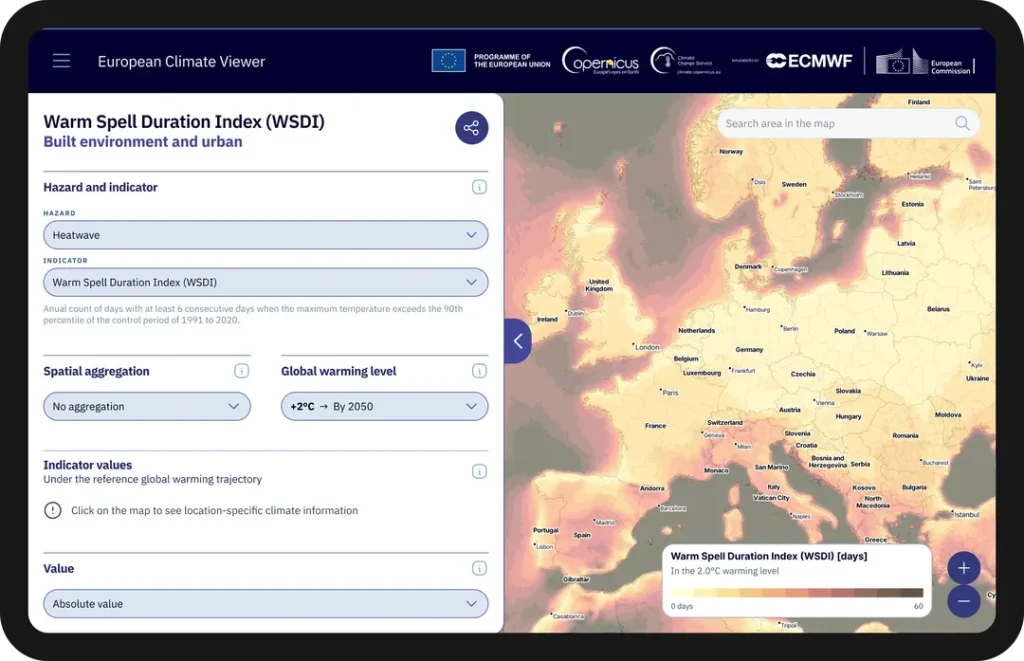
The regulation sets a common baseline scenario: 1.5 °C by 2030, 2 °C by 2050, and 3 °C by the end of the century relative to pre-industrial levels, assessed as multi-decadal averages. Member States are required only to encourage public authorities to integrate this trajectory into budgeting, spatial planning, and environmental impact assessments, meaning it does not constitute a rigid obligation. The trajectory would be translated into local, actionable data through a new digital tool, the European Climate Viewer. The Commission may update the trajectory via delegated acts, taking into account advice from the European Scientific Advisory Board on Climate Change (ESABCC).
2. Regular, Coordinated Climate Risk Assessments
The European Environment Agency (EEA) will prepare the EU-wide assessment by 30 June 2028, and Member States will deliver their national assessments by 30 June 2029, followed by subsequent updates every five years. Assessments must build at least on the reference trajectory and analyze extreme events, low-probability high-impact risks (tail risks), tipping points, cross-border, cascading, and compounding risks, as well as considerations for vulnerable populations and regions. For each significant risk, authorities must determine the level of urgency, potential measures, and residual risk. The assessments must be published, though Member States may withhold classified or security-sensitive information.
3. Policy Risk Owners
Each Member State must designate a central coordinating authority and, for each significant risk listed in Annex II, at least one authority responsible for its management (policy risk owner). Naming these risk owners is a mandatory component of national strategic plans.
4. A Single Strategic Plan
The Commission will adopt the EU Climate Resilience Strategic Plan by 30 September 2028, and Member States must adopt their national plans by 31 December 2030. This plan consolidates into a single document what previously constituted four fragmented planning elements: the national adaptation strategy, the national adaptation plan, and the adaptation components within National Energy and Climate Plans (NECPs) and Long-Term Strategies (LTS).
Each plan must set out: horizontal priorities, acceptable levels of residual risk, governance arrangements, provisions for vulnerable groups and regions, investment needs and potential funding sources, as well as targets, timelines, indicators, and measures across the 13 EU-priority policy areas (Annex III).
The regulation explicitly mandates the promotion of nature-based solutions and ecosystem-based adaptation, the integration of just resilience, and proof that implemented measures do not lead to maladaptation.
5. Streamlined Monitoring
The Commission introduces no new standalone reporting burden: Member States will incorporate reporting under the recast Article 19 of the existing Governance Regulation (2018/1999), starting 15 March 2029, and biennially thereafter. The Commission will evaluate Member States’ progress starting in 2028. Union indicators (Annex V) will include: climate-attributable deaths, associated economic losses, the share of uninsured climate losses, and Member States’ climate-related contingent liabilities and fiscal costs. Eurostat will publish data on fatalities and economic losses by 31 December 2030, and annually thereafter.
Beyond Legislation: Tools and Accompanying Measures
According to the proposal, the goal is to make the management of climate risks a routine consideration in infrastructure, investment, and policy decisions, rather than treating adaptation as an isolated environmental exercise.
Climate Viewer
Digital Tools
-
European Climate Viewer: Developed by the European Centre for Medium-Range Weather Forecasts (ECMWF), this tool displays projected climate hazards across Europe on interactive maps. Thanks to the Commission’s “Destination Earth” initiative, it will later integrate supercomputing capabilities.
-
Navigator of Climate Resilience Tools: An instrument developed by the European Environment Agency to help identify usable resources based on geographic location, sector, and specific risk.
-
Mission Solutions Explorer: Showcases real-world examples of adaptation measures developed and piloted under the EU Mission on Adaptation to Climate Change.
Cities and Vulnerable Communities
With approximately 75% of Europeans living in cities and urban areas, the Commission treats local and regional adaptation as a high priority. The framework will assist public authorities—especially communities with limited financial or technical capacity—through pilot projects, technical advisory support, and improved access to data and information.
Planned Accompanying Initiatives
-
European heatwave plan.
-
Climate Resilience Insurance Alliance.
-
European Water Initiative.
-
PreparEU advisory group on disaster preparedness.
-
Identification of Europe’s 100 most climate-vulnerable areas.
-
EU Climate Resilience Strategic Plan in 2028, aligning with the regulation’s deadline of 30 September 2028.
Timeline
The earliest milestone falls in mid-2028, while the deadline for national strategic plans is 31 December 2030.
| Deadline | Milestone |
| 30 June 2028 | EU-wide Climate Risk Assessment (EEA) |
| 30 September 2028 | EU Climate Resilience Strategic Plan |
| 15 March 2029 | First Member State reporting |
| 30 June 2029 | National Climate Risk Assessments |
| 31 December 2030 | National Strategic Plans |
| 30 September 2033 | Review |
These deadlines are fixed calendar dates and are not contingent upon the exact date of entry into force. Risk assessments and strategic plans follow a five-year cycle; Member State reporting occurs every two years, and the Commission will assess Member States’ progress biennially starting in 2028.
What Does This Mean in Practice, and What Remains Open?
Member States
Most of the new tasks fall on the Member States, concentrated around 2029–2030:
-
Complete a National Climate Risk Assessment by 30 June 2029 (including regional breakdowns where applicable, building at least upon the EU assessment).
-
Designate a central coordinating authority, as well as a designated policy risk owner for every significant risk.
-
Adopt a National Strategic Plan by 31 December 2030, complete with cost estimates, timetables, funding streams, and public/local consultation.
-
Coordinate with neighboring Member States (which can be satisfied via cross-border consultations under Strategic Environmental Assessments, provided conditions are met).
-
Submit biennial Climate Resilience Reports starting 15 March 2029.
In return, adaptation planning requirements will be removed from National Energy and Climate Plans (NECPs) and Long-Term Strategies (LTS). The regulation will not affect national defense or security operations, and classified data may be withheld from publication.
Businesses
The regulation imposes no direct compliance obligations on the private sector. Since the impact assessment identified private-sector unpreparedness as one of the three core challenges, the proposal seeks to indirectly raise risk awareness and drive adoption through three channels:
-
Common data baseline: Risk assessments must be made public, and the European Climate Viewer will provide localized hazard data.
-
Public sector leverage: Authorities are encouraged to account for the reference warming trajectory in budget planning, spatial planning, and environmental impact assessments—extending to procurement and permitting.
-
Insurance: Union-level monitoring metrics will track the share of uninsured climate losses, and the European Insurance and Occupational Pensions Authority (EIOPA) is set to establish an observatory on catastrophe risk insurability.
Although at least 60% of feedback during the public call for evidence called for mandatory “resilience-proofing” of all public spending and procurement, the proposal leaves this as an encouraged practice at the planning stage rather than a binding requirement.
Open Questions
-
Who finances the execution? The legislative financial statement lists €0 across all budget lines for 2028–2034, as the Commission plans to cover new administrative tasks via internal redeployment. Financing for national measures is left to national/regional partnership plans and the upcoming Multiannual Financial Framework (MFF), which remains under negotiation.
-
What constitutes “acceptable residual risk”? Under the regulation, it is defined as the level deemed acceptable by decision-makers when adopting the plan, considering uncertainties alongside financial, technical, and political constraints. This grants Member States wide discretionary leeway.
WWF EPO Critique
On 28 October, the WWF European Policy Office (EPO) published an analysis on LinkedIn highlighting the missing puzzle pieces of the proposal.
Severe storms, floods, droughts, and wildfires are becoming increasingly frequent across Europe, and their economic toll is climbing rapidly. Households, farmers, businesses, and public budgets are increasingly bearing the brunt of extreme weather. Two summers ago, the heatwaves, droughts, and floods that battered large parts of Europe caused €43 billion in damage. When the climate crisis inflicts such severe economic and social damage, who ultimately pays?
As regions become more vulnerable to weather-induced devastation, insurance coverage grows prohibitively expensive or disappears altogether, leaving communities financially exposed. This phenomenon—the “insurance protection gap”—frequently forces governments to intervene as insurers of last resort, which can destabilize entire national economies.
According to the EPO, the EU has recognized the challenge of insurability and acknowledged the need for action. The European Commission recently launched its Climate Resilience Framework and announced the creation of the Climate Resilience Insurance Alliance to bring together insurers, public authorities, and investors to develop solutions.
However, the EPO warns that while acknowledging the problem is crucial, expanding insurance coverage merely acts as a band-aid. Europe cannot simply insure its way out of the climate crisis. Tackling the root cause and mitigating physical climate risks is the only way to halt spiraling losses.
Insurance Alone Will Not Close the Gap
Healthy ecosystems represent one of Europe’s most effective lines of defense. Wetlands absorb floodwaters, peatlands retain water to mitigate drought conditions, and forests prevent soil erosion. Yet nature-based solutions are largely missing from the Commission’s plans to bridge the insurance protection gap. As climate impacts intensify, investing in nature must become a centerpiece of the puzzle.
Private insurers cannot solve this crisis alone—and according to a recent investigation by Inside Track, they show little appetite to do so. Drawing on industry insider accounts, the report suggests major insurers systematically, and at times deliberately, downplay climate risks to capture short-term commercial gains. Simultaneously, many insurers appear to be preparing for escalating premiums and market retreat in high-risk zones.
Public support therefore plays a vital role. Public-private risk-sharing and reinsurance arrangements could prove decisive in preserving economic stability and keeping homes and businesses insurable. However, such public backing must be paired with strict conditionalities that incentivize disaster prevention, adaptation, and proactive resilience-building.
The framework also misses an opportunity to forge tighter links between climate adaptation and the EU’s financial and prudential regulatory frameworks. As the protection gap widens, it increasingly threatens macroeconomic and financial stability. Yet the Commission has stopped short of proposing that insurance and financial regulations be systematically leveraged to drive risk prevention, adaptation, and long-term risk reduction.
Building a Resilient Insurance System
Closing the insurance protection gap requires sustained commitment and long-term vision. This entails aligning insurance mechanisms directly with disaster prevention, adaptation planning, and full recognition of the economic value of nature-based solutions.
These priorities were recently detailed in a joint letter to the European Commission by WWF EU, Finance Watch, and ShareAction, calling for elevated ambition across the Climate Resilience Framework and the Climate Resilience Insurance Alliance.
While the Alliance represents a meaningful step toward addressing the protection gap, actively involving affected communities and civil society organizations will be essential to provide grounded perspectives and ensure that resulting initiatives deliver tangible impacts.
Europe’s insurance dilemma is ultimately a resilience challenge. If policymakers focus solely on compensating post-disaster losses, financial relief will offer only temporary respite while the protection gap continues to widen. Only when insurance tools, public investments, and nature restoration operate in unison to lower risks before disaster strikes can Europe build a resilient and genuinely insurable future.