
Where Does the EUDR Come From, and Why Now?
The scale of global deforestation is alarming. According to data from the Food and Agriculture Organization of the United Nations (FAO), approximately 10 million hectares of forest disappear each year worldwide. A significant share of this loss is directly linked to agricultural expansion – rainforests are cleared to make way for soy cultivation, palm oil production, cattle ranching, cocoa farming, and coffee plantations. As one of the world’s largest trading blocs, the European Union has also been an active contributor to this process. EU consumption is estimated to account for around 10% of global deforestation.
The EU’s response is Regulation (EU) 2023/1115, commonly referred to as the EUDR (EU Deforestation Regulation). The Regulation was adopted on 31 May 2023 and entered into force on 29 June 2023. Its objective is clear: to prevent products associated with deforestation or forest degradation from being placed on the EU market. The EUDR replaces the EU’s previous timber legislation, the EU Timber Regulation (EUTR), which had been in force since 2013.
It is important to emphasize that the EUDR is a regulation, not a directive. As such, it applies directly and uniformly across all EU Member States without requiring national transposition. This means there is no room for national exemptions or dilution of the rules, and companies cannot rely on the pace of implementation in individual Member States when preparing for compliance.
No Further Than 31 December 2020
The key concept of the EUDR is that products must be deforestation-free. This does not simply mean that a product is generally unrelated to deforestation; rather, compliance is tied to a specific cut-off date. Manufacturers and operators must be able to demonstrate that no deforestation or forest degradation has occurred on the land used to produce the relevant commodity or product after 31 December 2020.
This reference date fundamentally shapes the entire compliance process, as all supporting evidence and documentation must be capable of demonstrating compliance with respect to that date and thereafter.
Seven Commodities and Hundreds of Products
The scope of the EUDR covers seven key commodities and a wide range of products derived from them.
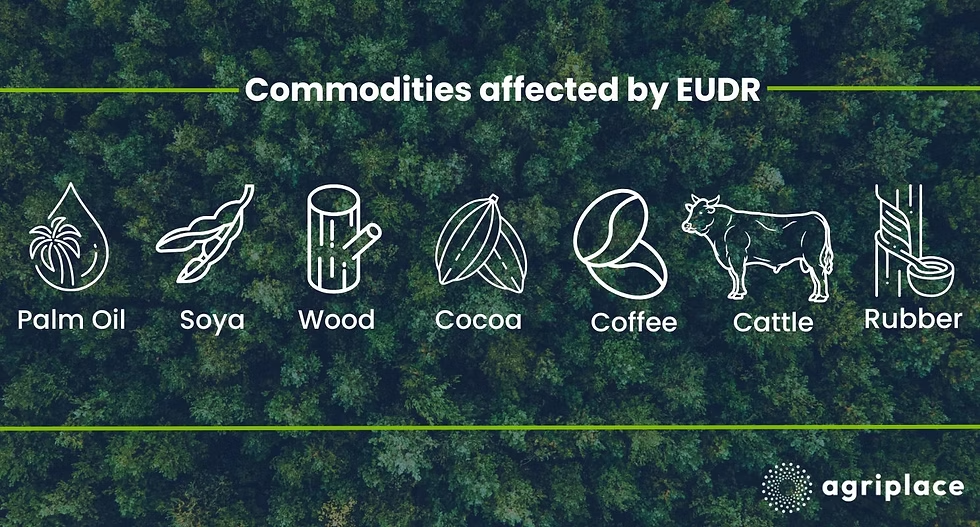
The commodities concerned are:
- Cattle
- Cocoa
- Coffee
- Palm oil
- Rubber
- Soy
- Wood
The Regulation also applies to products derived from these commodities, which is often where many companies are surprised to discover that they fall within its scope.
The range of affected products is extensive. According to Annex I of the Regulation, it includes, among others, leather products, chocolate, glycerine, pneumatic tyres, wooden furniture, paper products, soy-based products, and books. In other words, the EUDR affects not only traders and processors of raw materials, but also companies that place on the EU market products containing or derived from these materials.
The Regulation applies to all relevant commodities and products placed on the EU market, regardless of whether they were produced within or outside the European Union. Consequently, both imported goods and domestically produced products are subject to its requirements.
Economic Operators Covered by the EUDR
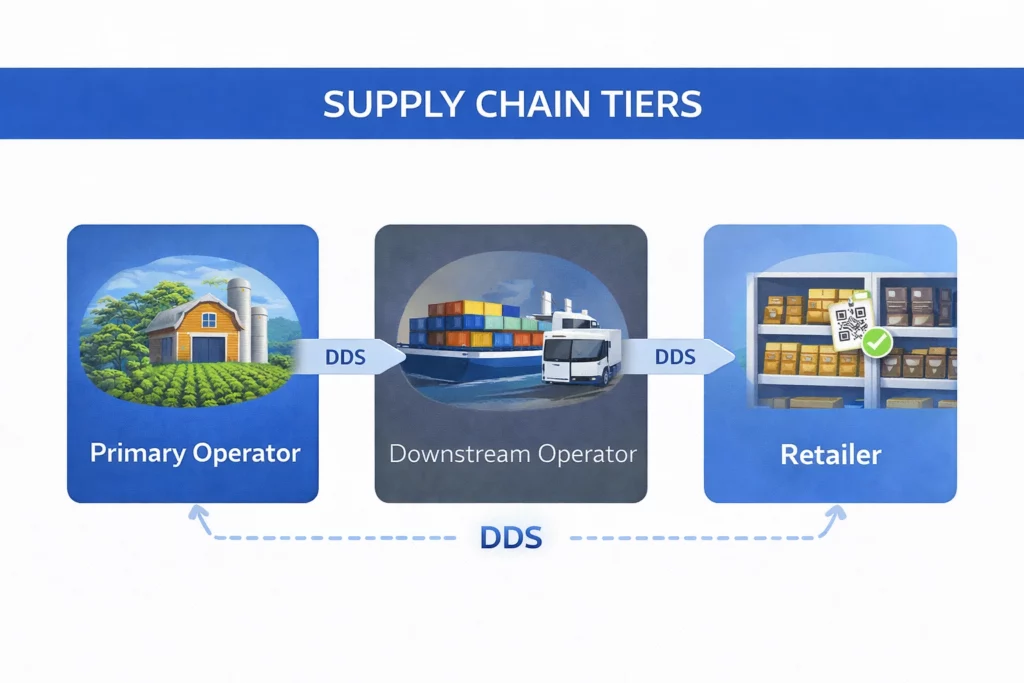
The EUDR – particularly following the amendments introduced by Regulation (EU) 2025/2650, which entered into force in December 2025 – distinguishes between three categories of economic operators, each subject to different obligations.
Operator
An operator is a person or entity that places a relevant product on the EU market for the first time or exports it from the European Union. This category typically includes importers, processors, and manufacturers.
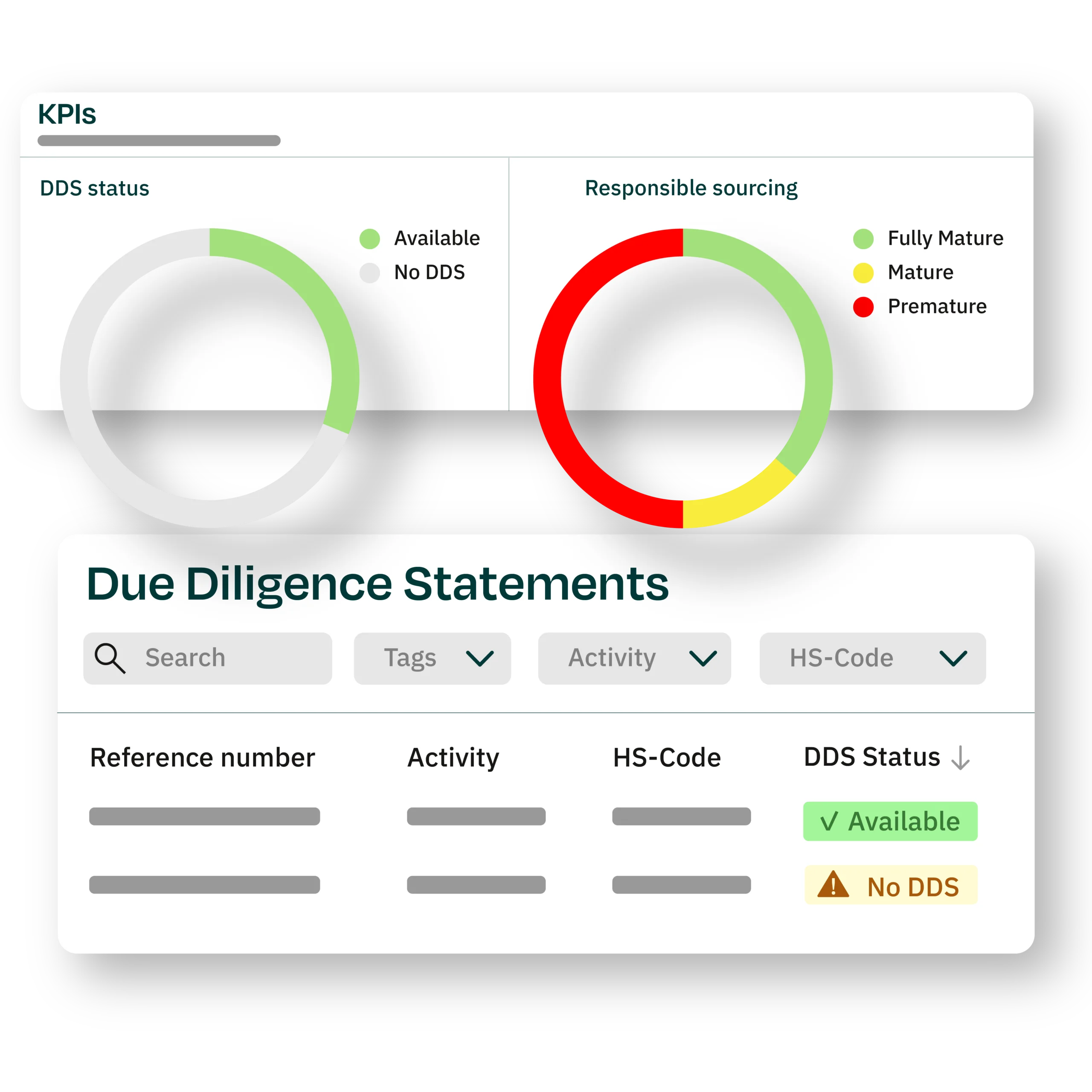
Operators bear the most extensive obligations under the Regulation. They are responsible for establishing and maintaining a comprehensive due diligence system, collecting the required information, carrying out risk assessments and risk mitigation measures, and submitting a Due Diligence Statement (DDS) through the EUDR Information System.
Downstream Operator
A downstream operator is an entity that places products on the market on the basis of an existing DDS or a simplified due diligence statement.
These operators are generally not required to submit their own DDS. However, they must maintain traceability throughout the supply chain and retain all relevant records and documentation for at least five years.
Trader
A trader is a company that further distributes products within the supply chain, including wholesalers, distributors, and retailers.
Non-SME traders are subject to obligations similar to those of downstream operators, particularly with regard to traceability and record retention. Small and medium-sized enterprises (SMEs) benefit from simplified compliance requirements and reduced administrative obligations.
DDS: What Does It Mean in Practice?
At the heart of EUDR compliance lies the establishment and operation of a due diligence system. This is not merely a paperwork exercise, but a documented and functioning process built on three key pillars:
1. Information Collection
For each relevant product, the operator must be able to provide:
The GPS coordinates of the production area (in polygon format where the plot exceeds four hectares);
The harvest or production date, demonstrating that no deforestation or forest degradation occurred after 31 December 2020;
Documentation proving the legality of production, including land-use rights, compliance with labour legislation, and respect for the rights of indigenous peoples;
Information on all relevant actors within the supply chain, including names, addresses, and contact details.
These records must be retained for at least five years.
2. Risk Assessment
Based on the information collected, operators must assess whether the production of the product may be linked to deforestation or forest degradation.
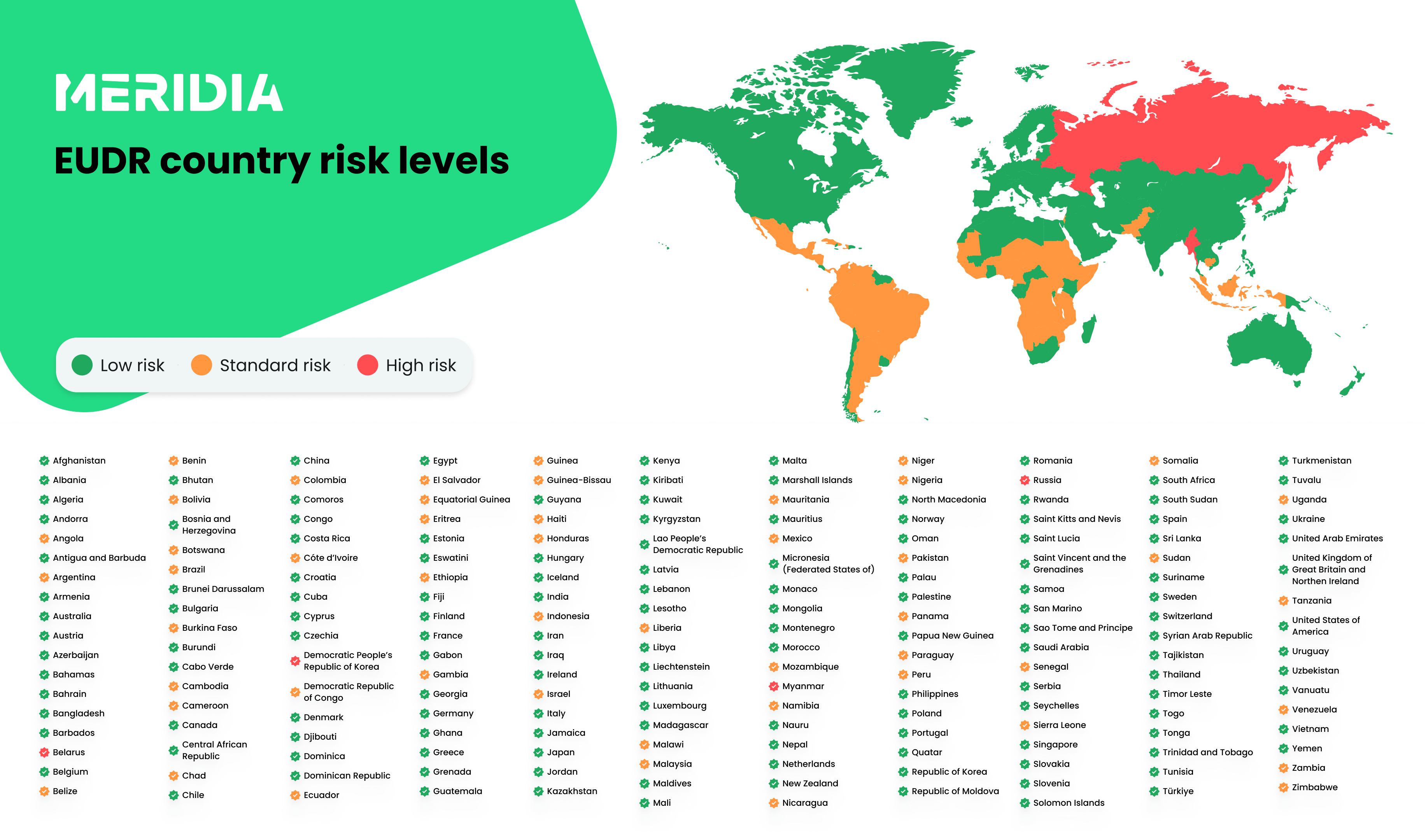
In May 2025, the European Commission published its country benchmarking system. According to this classification, 140 countries are considered low risk, including all EU Member States, the United States, Canada, China, Ukraine, and Thailand. Four countries are classified as high risk: Belarus, Myanmar, North Korea, and Russia. All remaining countries fall into the standard-risk category.
The country risk classification determines the level of scrutiny and verification required during the due diligence process.
3. Risk Mitigation
Where the risk assessment does not clearly result in a negligible or low-risk conclusion, appropriate risk mitigation measures must be implemented. These may include enhanced supply chain audits, independent third-party verification, additional supporting documentation, or replacing the relevant source of supply altogether.
Once the operator has concluded that the product complies with the EUDR requirements and is deforestation-free, a Due Diligence Statement (DDS) must be submitted through the EU’s TRACES NT system. This electronic platform forms the basis of EU-wide traceability and regulatory oversight under the Regulation.
Staggered Deadlines
The EUDR has had a long and somewhat turbulent history when it comes to implementation deadlines. The original application date was postponed twice, partly due to concerns about companies’ preparedness, delays in the development of the EU’s IT systems, and the complexity of supply chain traceability requirements.
Under the amendments introduced by Regulation (EU) 2025/2650, the currently applicable deadlines are as follows:
30 December 2026 – Large and Medium-Sized Companies
This is the date on which full EUDR compliance becomes mandatory for the majority of affected businesses. From this point onward, relevant products may not be placed on the EU market or exported from the EU without a valid Due Diligence Statement (DDS) and a compliant due diligence system.
30 June 2027 – Micro and Small Enterprises
Businesses employing fewer than ten people and having an annual turnover or balance sheet total not exceeding EUR 2 million benefit from an additional six-month transition period.
An Important Addition
The amendment also introduced a simplified due diligence statement for primary operators that qualify as small or micro-sized enterprises, thereby reducing their administrative burden.
Sanctions: What Is Really at Stake?
The consequences of non-compliance can be severe. The Regulation requires Member States to establish effective, proportionate, and dissuasive penalties, including:
Immediate prohibition of placing the relevant products on the EU market;
Withdrawal and recall of products already placed on the market;
Financial penalties designed to eliminate any economic benefit gained from the infringement, with the Regulation specifically requiring Member States to provide for fines of at least up to 4% of the value of the relevant goods;
Temporary suspension of access to the EUDR Information System;
Exclusion from public procurement procedures.
The implementation of these sanctions remains the responsibility of individual Member States. In Hungary, enforcement falls under the authority of the National Food Chain Safety Office (NÉBIH), which is empowered to conduct inspections and impose penalties for infringements.
Hungary and the EUDR
As the EUDR is a regulation rather than a directive, it does not require transposition into Hungarian law and applies directly and uniformly. Nevertheless, practical implementation and enforcement take place at the national level, and Hungary has already taken several concrete steps in this regard.
The Designated Competent Authority: NÉBIH
The Hungarian Government has designated the National Food Chain Safety Office (NÉBIH) as the competent authority responsible for coordinating and supervising the implementation of the EUDR in Hungary.
NÉBIH maintains a dedicated and regularly updated information platform containing guidance materials, summaries, and the latest developments relating to the Regulation. For Hungarian businesses, this serves as the primary national source of information on EUDR compliance.
A Preliminary Ruling Procedure with Hungarian Relevance
A noteworthy development is that a Hungarian-related preliminary ruling procedure concerning the EU Timber Regulation (EUTR), the predecessor of the EUDR, was brought before the Court of Justice of the European Union (CJEU). The Court delivered its judgment in 2025.
The ruling addresses the interpretation of due diligence obligations and may provide important guidance for the practical application of the EUDR, particularly for Hungarian forestry operators and companies within the timber sector.
Information and Guidance through the National Chamber of Agriculture (NAK)
The National Chamber of Agriculture (NAK) plays an active role in raising awareness of the EUDR in Hungary. It regularly publishes updates, guidance materials, and practical information, particularly for stakeholders in the forestry and agricultural sectors.
Additional support materials tailored to the specific circumstances of Hungarian forest owners and forestry operators are also being developed.
Who Is Affected in Hungary?
Within Hungary, the EUDR is particularly relevant to the following sectors:
Food Industry and Food Trade
Companies dealing with cocoa, coffee, soy-based products (such as vegetable oils and animal feed), palm oil used in food and cosmetics, beef, and leather products may fall within the scope of the Regulation. Food manufacturers and distributors processing or marketing imported raw materials are especially likely to be affected.
Timber, Furniture, and Paper Industries
Wood products, furniture, wooden packaging materials, paper, and printed products derived from forest resources are all covered by the EUDR. This is one of the most sensitive sectors for Hungarian businesses, particularly those importing or processing timber products.
Rubber Processing and Automotive Supply Chains
Natural rubber and products manufactured from it—including tyres, seals, and other rubber components—also fall within the scope of the Regulation.
Retailers and E-Commerce Businesses
Companies selling relevant products on the EU market, such as chocolate, coffee, furniture, or timber products, may also become subject to EUDR obligations, even where simplified requirements apply.
Why Act Now?
At first glance, 30 December 2026 may appear to be a distant deadline. In reality, companies that postpone preparations until the final months are unlikely to achieve compliance in time.
EUDR compliance is typically a multi-month, and often multi-year, process involving:
Comprehensive mapping of affected product portfolios;
Identification and engagement of all relevant actors within the supply chain;
Collection and verification of geolocation data, sometimes directly from producers located thousands of kilometres away;
Development of risk assessment and documentation systems;
Registration within the EU TRACES NT system;
Establishment of internal processes, responsibilities, and training programmes;
Potential restructuring of supply chains where existing sources are found to present unacceptable risks.
Obtaining geolocation data can be particularly challenging and time-consuming. In many cases, small-scale producers at the beginning of the supply chain do not possess GPS coordinates, and digital infrastructure may be limited. Addressing these issues requires considerable time, resources, and coordination.
Closing Thoughts
The EUDR is not a challenge of the distant future. It is already a binding European regulation, and its application deadlines are approaching rapidly. Compliance is not merely a legal obligation; it is increasingly becoming a competitive advantage, as investors, customers, and business partners place greater value on sustainable and transparent supply chains.
In the global fight against deforestation, the European Union has significant influence. Compliance with the EUDR means ensuring that business activities do not contribute—whether intentionally or unintentionally—to the destruction of the Amazon rainforest, the forests of Borneo, or the savannah ecosystems of Africa. Today, this is no longer simply an ethical position; it is a legal requirement.
If you would like to understand where your business stands on the path toward EUDR compliance, or how to begin preparing effectively, contact the team at Planet Fanatics’ Network Ltd. Let us map the journey together.