
Author: Katalin Szomolányi
A day for and with those who channel climate anxiety into action.
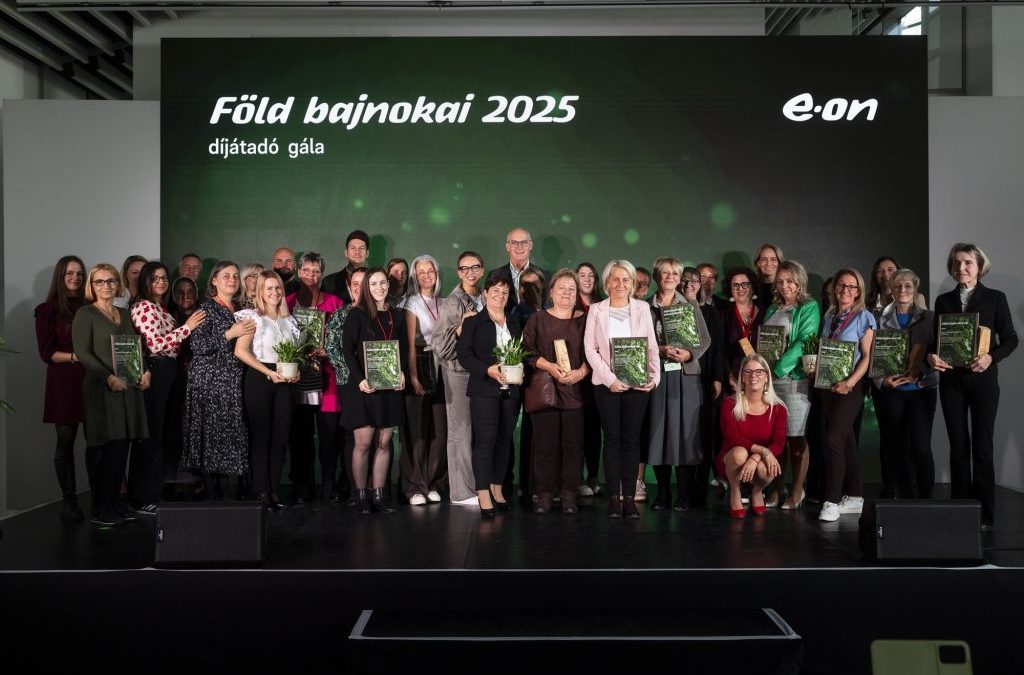
This is the third consecutive year that E.ON, the energy company operating the power grid in Transdanubia, Pest County, and Budapest, has awarded kindergarten and school communities. This year, approximately 350 entries were received, from which 13 projects were recognized and granted up to 2.5 million HUF each, based on the evaluation of a jury. The jury members included Guntram Würzberg, CEO of E.ON Hungária Group; Diána Ürge-Vorsatz, Vice Chair of the IPCC; Lia Pokorny, actress; Réka Nagy (Ökoanyu), climate communication expert; and myself, Katalin Szomolányi, founder and managing director of Planet Fanatics’ Network. With 1,200 submissions to date, 42 winning institutions, and a total of 75 million HUF in support, the competition has grown into a nationwide movement.
A generation may grow up for whom the fundamental attitude towards sustainability and their own adulthood is not passive worry for the environment, but active shaping of the future. This could be the most important result of the process E.ON started with the Champions of the Earth competition. Through the initiative—which has now reached every tenth Hungarian kindergarten and school directly or indirectly—around 9,000 children have experienced that the environment around us can be protected and that the world will be what we shape it to be together through our decisions and actions.
2025 Champions of the Earth
In Decs, Tolna County, preschoolers learn about responsible animal husbandry and crop cultivation through a mini poultry yard and kitchen garden. In the Gyál kindergarten’s eco-camp, a story trail is being established with educational islands, a garden pond, and a hedgehog garage to bring the complexity of wildlife truly close to the little ones. In Vác, Hungary’s first school sponge garden helps students master responsible and sustainable water use.
The school garden in Kelenvölgy is being expanded with renewable energy, wetland, and bee-friendly elements. The community of the Kunpeszér school is planting a climate-friendly forest. In Visegrád, students observe protected bats living in the school’s basement using a monitoring station. The Gennaro Verolino High School in Budapest is building its inclusive sustainability program around school gardening, involving preschoolers, elementary students, and young people with autism spectrum disorder and moderate intellectual disabilities. A high school in Debrecen is launching a sustainability competition for all secondary schools in the region.
The winning entries and their currently envisioned projects are as follows:
Kindergartens
-
Decsi Tesz-Vesz Kindergarten: “Tesz-Vesz Farm”
-
Gyáli Tátika Kindergarten, Bartók Béla Road Site: “Pötyi and Friends”
-
Ongai Bársonyos Kindergarten and Nursery: “Green Wizards”
-
Piliscsabai Szent László Kindergarten: “Love the Birds of the Sky!”
-
Szombathelyi Hétszínvirág Kindergarten: “Rainbow Flower – Green World”
Primary Schools
-
Apátkúti Forest Primary School: “Bat Station”
-
Budapest School Primary and High School: “An Oasis for Our School!”
-
Kelenvölgyi Primary School: “Sustainable Garden Project” – Audience Award Winner
-
Kunpeszéri Primary School: “Building a (Beautiful) Climate-Friendly Forest”
-
Pilisborosjenői German Ethnic Primary School: “Eco-Bandits for the Future”
-
Váci Juhász Gyula Primary School: “Sponge Garden”
High Schools
-
Budapest Gennaro Verolino Kindergarten, Primary School, Skills Development School and Dormitory: “Colorful Hearts for a Green Future”
-
Debreceni Csokonai Vitéz Mihály High School: “With Momentum for a Sustainable Future”
Personal Experience
The reason I hold this project in high regard, both professionally and personally, is the consistent and genuine care for future generations. This is not a one-day, “the agency will handle it” award ceremony, but almost a full year of work.
The award gala is about allowing the winners to grow emotionally, professionally, and communally. Winners from the previous year also attended this year—this is how a community is formed. There was a professional discussion in the form of a roundtable (which was actually a rectangle ;)), and a professional lecture given by Diána Ürge-Vorsatz. There was laughter thanks to the Itt és Most (Here and Now) improvisational theater and Gergely Litkai’s presentation, there was a singing lesson, and even a Nature Trail game.
A full day for those educators who, on top of their daily work, take on the task of inventing and coordinating actions aimed at environmental education, shaping a vision of the future, and alleviating anxiety for children and young people.
A day when—for the third year now—I feel at this event that the E.ON organizers truly do everything they can to ensure that the educators and winners are recharged both emotionally and professionally on this day, thanks to their genuine care.
This is why participating in this program is a grateful task. Thank you! I encourage everyone involved to join the Champions of the Earth community next year and apply.
[We wrote about the 2024 Champions of the Earth here, and the 2023 ones here.]