
What is REPowerEU?
In response to the challenges caused by Russia’s invasion of Ukraine and disruptions in global energy markets, the European Commission implemented the REPowerEU plan to gradually phase out imports of Russian fossil fuels.
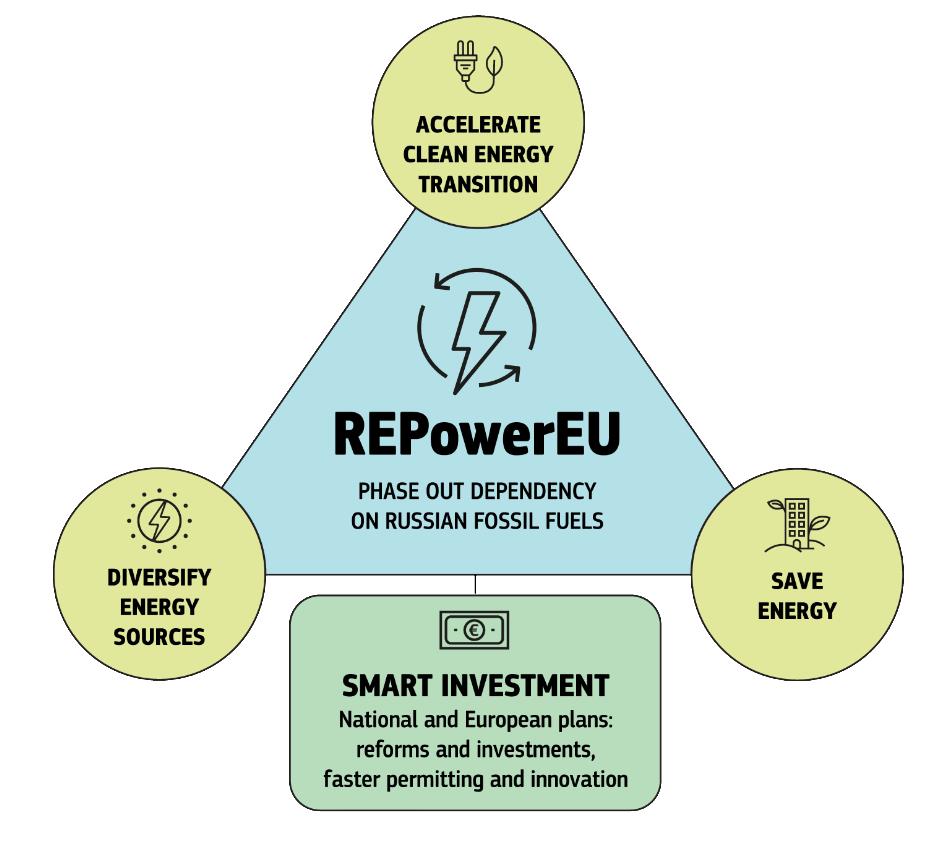
Launched in May 2022, REPowerEU helps the EU save energy, diversify its energy supply, and produce clean energy.
REPowerEU aims to protect EU citizens and businesses from energy shortages, support Ukraine by weakening Russia’s war chest, accelerate the transition to clean energy, and stabilize energy prices.
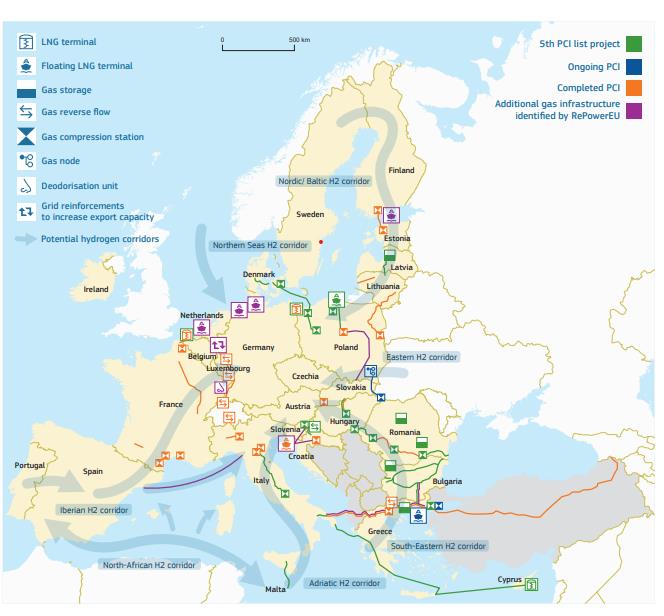
Map of European gas infrastructure – projects of common interest (PCIs) and additional projects identified under REPowerEU, including hydrogen corridors
The EU plans the following:
-
Gas – Halting all imports of Russian pipeline gas and liquefied natural gas (LNG) by November 2027.
-
Oil – Taking measures against the Russian “shadow fleet” (vessels used by Russia) transporting oil to circumvent sanctions, and stopping Russian oil imports by the end of 2027.
-
Nuclear energy – Restricting imports of uranium, enriched uranium, and other nuclear materials originating from Russia.
Despite the progress achieved, in 2025 the EU still imported 36 billion cubic meters of Russian natural gas, 9.7 million tonnes of crude oil, and nearly 2,900 tonnes of enriched uranium or nuclear fuel from Russia. To phase out the remaining Russian energy imports, the Commission presented the REPowerEU Roadmap in May 2025, outlining the gradual withdrawal of Russian oil, natural gas, and nuclear energy from EU markets.
Key achievements and targets
-
Since the outbreak of the Russia–Ukraine war, the EU’s dependence on Russian natural gas dropped from 45% of total gas imports to 12% by 2025.
-
All imports of Russian coal are prohibited by EU sanctions.
-
The share of Russian crude oil imports decreased from 27% in early 2022 to 2%; currently, only two EU Member States still import Russian oil (Hungary and Slovakia).
-
The 35 billion cubic meters of Russian natural gas still entering the EU annually will be completely removed from the EU market in less than two years.
The REPowerEU Gas Regulation On February 3, 2026, the REPowerEU Gas Regulation entered into force, turning one of the REPowerEU plan’s objectives into legally binding legislation. The regulation mandates the phased, permanent phase-out of Russian liquefied natural gas (LNG) imports in 2026, followed by the cessation of Russian pipeline gas imports in 2027. Compliance with these measures is ensured across the EU through an enforcement framework featuring uniform sanctions and safeguards.
As the global landscape continues to evolve—particularly due to ongoing instability in the Middle East—maintaining resilience remains a top priority. Uncertainty and market volatility stemming from any disruption or closure of the Strait of Hormuz further reinforce the importance of the REPowerEU objectives and strategy. Rising global prices for fossil fuels directly increase costs for the EU.
Energy Savings One of the primary goals of REPowerEU is saving energy and enhancing energy efficiency, as the safest, cleanest, and cheapest energy is the energy that is not consumed. Accordingly, the EU has adopted decisive measures to reduce overall natural gas demand and rapidly curb dependence on Russian imports.
-
Reducing natural gas demand and increasing energy efficiency
-
Heat pumps
-
Electric vehicles
-
AccelerateEU – Energy Union
Nearly all EU Member States have integrated energy efficiency investments into their Recovery and Resilience Plans, alongside supporting investments and reforms aimed at renewables, energy infrastructure, and the diversification of energy supplies.
Security of Natural Gas Supply Gas storage facilities play a pivotal role in the EU’s energy security, covering approximately one-third of winter natural gas consumption. Demand reduction and adequate storage levels help stabilize energy prices.
After Russian companies halted gas injections into European storage sites and reserves fell to an all-time low in November 2021, the EU mandated that storage facilities reach at least a 90% filling level prior to each winter. This target was achieved months ahead of winter in both 2023 and 2024.
Because the regulation was set to expire at the end of 2025 and the global energy market remained uncertain, the Commission proposed extending the Gas Storage Regulation until the end of 2027. The EU adopted this amendment in September 2025, ahead of the winter season.
In spring 2026, storage reserves remained stable, though below the five-year average. Amid ongoing market uncertainty, the Commission is encouraging Member States to leverage the flexibilities provided by the regulation and apply an 80% target where possible early in the filling season, thereby providing market predictability.
Clean Energy Production REPowerEU places accelerating clean energy generation at the core of EU efforts to strengthen energy security and decarbonize the economy. In October 2023, the EU adopted an amendment to the Renewable Energy Directive, raising the binding target for renewable energy in overall consumption to at least 42.5% by 2030, with an ambition to reach 45%.
The EU has substantially scaled up its renewable energy generation. The share of renewables in the energy mix rose from 10% in 2006 to 25% in 2024. Since 2021, the EU has installed 260 GW of new renewable capacity (comprising 204 GW of solar and 57 GW of wind power), yielding natural gas savings in power generation worth €5.6 billion in 2025.
Since 2022, the EU has deployed renewables at a record pace: wind and solar generation expanded by more than 50% over the past five years. Together, they now generate 31% of the EU’s electricity, outpacing fossil fuels.
Energy storage is playing an increasingly critical role in integrating and expanding renewable energy sources. According to April 2026 data from the European Energy Storage Inventory, the EU currently operates around 55 GW of installed energy storage capacity, with over 30 GW of additional capacity in the permitting or construction phases, predominantly in the form of battery storage systems.
Timeline
-
March 8, 2022 – The Commission presents the initial proposal to phase out Russian fossil fuels via the REPowerEU plan.
-
February 3, 2026 – The REPowerEU regulation on the phased withdrawal of Russian fossil fuel imports enters into force.
-
February 9, 2026 – The European Commission adopts an implementing decision establishing the list of third countries exempt from prior authorization requirements for gas imports into the Union.
-
March 18, 2026 – The Commission updates its guidance on the REPowerEU Gas Regulation.
Roadmap to Fully Phasing Out Dependence on Russian Energy EU Member States were required to submit national diversification plans to the Commission by March 1, 2026, setting out detailed measures and milestones for phasing out direct and indirect Russian gas and oil imports. Concurrently, efforts continue to accelerate the EU’s energy transition and diversify energy supplies to eliminate risks to security of supply and market stability.
The AccelerateEU Package In April 2026, the Commission introduced AccelerateEU, a new package of measures designed to address rising energy costs and further reduce dependence on oil and gas, particularly amid escalating tensions in the Middle East. The initiative enhances coordination among Member States, accelerates the transition to secure and affordable clean energy, and stimulates both public and private investment.
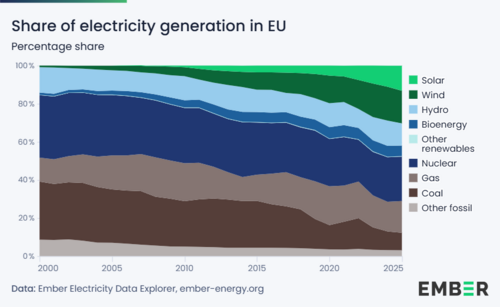
Share of electricity generation between 2000 and 2025