
UNEP’s 2026 report, Limiting Overshoot, is founded on a conclusion the agency spent years trying to avoid stating outright: the world will soon cross 1.5°C. A single hot year above the threshold does not mark the breach itself; 2024 was the first full calendar year to exceed it, and the three-year average through 2025 did so as well. For the Paris Agreement target, what counts is long-term warming, typically assessed over decades (though the treaty text itself sets no precise averaging period). Emissions, however, have not fallen rapidly enough to keep the long-term average below 1.5°C over the next several years, making the breach inevitable.
None of this means the target should be dismissed. On the contrary: 1.5°C remains the critical long-term benchmark, and exceeding it will never be safe or acceptable. “There are no good outcomes above 1.5°C,” noted Inger Andersen, Executive Director of UNEP. What changes is the operational vector: the target must now be approached from above. And 1.8°C is where the situation turns perilous, because the report also concludes that if warming climbs significantly above 1.8°C, drawing it back down to 1.5°C within this century becomes extremely difficult.
A 1.5°C rise is already dangerous. A 1.5°C world carries high to very high risks across both natural and human systems. In its Sixth Assessment Report (AR6), the IPCC delivered a comprehensive assessment of the core risks at 1.5°C of global warming, identifying high or very high risks for unique and threatened systems—including coral reefs and other biodiversity hotspots—as well as the cryosphere, including the Arctic and mountain glaciers. In the IPCC framework, very high risks signify “severe impacts and significant irreversibility or persistence of climate-related hazards, combined with limited ability to adapt due to the nature of the hazard or impacts/risk.” When IPCC AR6 was published, the 1.5°C warming level—defined as a 20-year average—had not yet been reached. With 2024 marking the first single year where global mean surface temperature exceeded 1.5°C, the world has entered a 20-year window centered on 1.5°C of warming.
Many impacts assessed in AR6 are already materializing. Between 2023 and 2025, over 80% of tropical coral reefs experienced bleaching events, with mass bleaching documented across at least 83 countries and territories. Climate-driven global biodiversity loss is accelerating in tandem.
In February 2025, combined Arctic and Antarctic sea-ice extent hit an all-time low, and the oldest, thickest multi-year sea ice has plummeted by more than 95% since the 1980s. More than 40% of cumulative global glacier mass loss recorded since the 1970s occurred in the single decade from 2015 to 2024, with 6% lost in 2023 alone.
Extreme weather is intensifying across the board. IPCC AR6 rated extreme weather risks as high at 1.5°C, featuring unprecedented events that would have been virtually impossible without global warming. Such events are becoming more frequent, more intense, and more widespread.
Over the past two decades, more than 50 unprecedented, high-impact heatwaves have been documented. Concurrently, warming has increased the likelihood and intensity of tropical cyclones, floods, droughts, and wildfire events. Between May 2024 and May 2025, roughly half the global population endured at least 30 days of extreme heat. Heat-related mortality is surging worldwide as a result. During the 2025 European summer heatwave, heat-attributable deaths are estimated to have tripled, an increase directly linked to anthropogenic warming.
Overshoot Is a Pathway, Not Just a Moment
Global temperature change does not occur in an instant; it unfolds over decades. Ideally, if peak temperature can be constrained and then reversed, the 1.5°C overshoot traces an arc that the report terms an “overshoot peak and decline pathway,” or simply an “overshoot pathway.”
This pathway follows a four-stage trajectory: from overshoot (above 1.5°C) through peak warming (ideally capped below 2°C), down through decline, and ultimately to stabilization. Crucially, this pathway is not predetermined; every policy decision and mitigation action shapes its trajectory.
The geometry of this curve governs risk exposure. The duration of the overshoot and the height of its peak dictate the severity of climate impacts worldwide. The downward leg of the curve—the decline back to 1.5°C or lower—is by no means guaranteed; it depends on immediate and sustained long-term mitigation. The flatter and shorter the curve, the lower the damages—and that outcome rests entirely on current action.
Reversing global warming will be slow and demanding. It requires approximately 220 Gt of cumulative net negative CO₂ emissions to lower global temperatures by roughly 0.1°C. The sustainable scale and deployment rate of carbon dioxide removal (CDR) are therefore central to achieving net negative emissions, which in turn dictate the pace of cooling. Even under aggressive scenarios where net negative CO₂ reaches 10 Gt CO₂/year—about one-quarter of current global annual CO₂ emissions—temperatures would drop by merely ~0.05°C per decade. In practical terms, reversing a single decade of warming at the current rate (~0.25°C/decade) could take roughly 50 years, even under optimistic CDR assumptions. Current deployment falls far short: over the past decade, durable terrestrial CDR removed an average of 2 Gt CO₂/year, while novel technological CDR (engineered capture and durable storage) accounted for roughly one-thousandth of that volume.
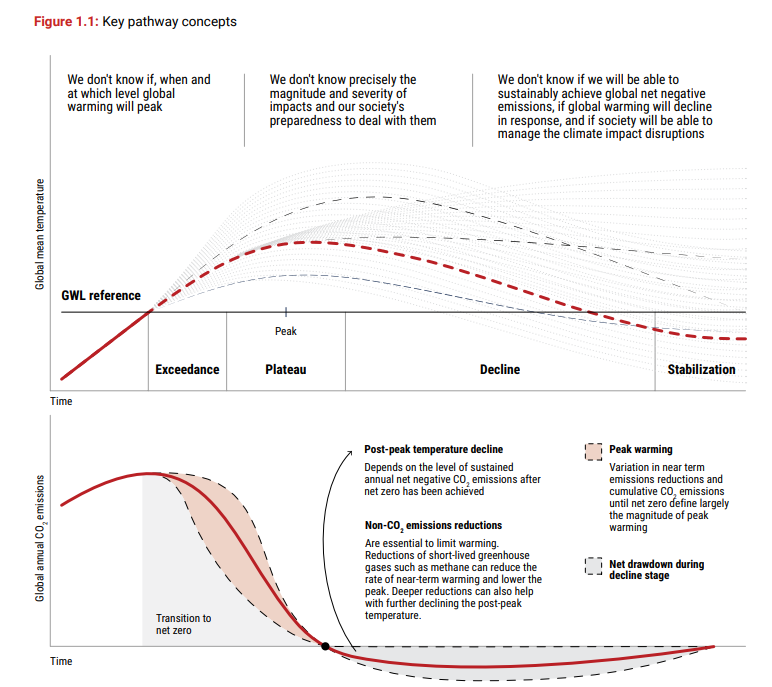
Source: UNEP, Limiting Overshoot: Navigating exceedance of 1.5°C and pathways towards return (2026), Figure 1.1.
The trajectory outlined in the report bears an awkward name and a simple geometry: overshoot, peak, and decline. Warming breaches the threshold, reaches a peak, lingers there, and then drops back below 1.5°C later in the century. According to UNEP, this entails four distinct stages: from the initial breach through the peak, down through the decline, and ultimately settling below the line. As the report underscores, this is by no means an acceptable or desirable path; it is simply the best remaining option. Overshoot describes the corner into which the world has backed itself, and the only viable path out. Treating it as a new target, or as a license to maintain current momentum and clean up later, completely misreads the reality.
Every Tenth of a Degree Is a Different World
Article 2 of the Paris Agreement commits nations to holding the increase in global average temperature well below 2°C above pre-industrial levels, and ideally at 1.5°C. Yet 1.5°C was never considered “safe.”
Even today, we are witnessing increasingly severe heatwaves, wildfires, droughts, extreme weather, and compounding risks to human populations and ecosystems. As we cross 1.5°C, climate impacts will amplify non-linearly. This could trigger irreversible tipping points, such as the dieback of the Amazon rainforest, permafrost thaw, and the collapse of polar ice sheets. Mitigation costs will skyrocket as we are forced to rely ever more heavily on carbon dioxide removal rather than straightforward emissions abatement. Changing climatic conditions will push systems past adaptation limits, raising acute climate justice dilemmas—including forced migration, the submergence of Small Island Developing States, and potential declines in global food production of up to 14% by 2050.
The immediate priority therefore remains rapid, deep, and sustained emissions reductions.
Because the peak will no longer be held at 1.5°C, the battle shifts to capping that apex as low as humanly possible: 1.6°C instead of 1.8°C; 1.8°C instead of 2.1°C. These increments are not rounding errors. UNEP ties tangible, real-world destruction to every step up. Global food production could contract by up to 14% by 2050 if adaptation lags. Glaciers could forfeit more than a quarter of their mass by century’s end, permanently altering freshwater supplies across downstream river basins for decades to come.
Higher peak temperatures also increase the probability of crossing thresholds from which recovery is impossible. The report highlights four such systems:
-
The West Antarctic Ice Sheet
-
The Greenland Ice Sheet
-
The Atlantic Meridional Overturning Circulation (AMOC), which moderates Northern Europe’s climate
-
The Amazon rainforest
Once tipped past these thresholds, a portion of the loss becomes permanent, even if the world subsequently lowers temperatures back down. A transient overshoot might be survivable. A permanent overshoot is not—and the height of the peak dictates which outcome unfolds.
Mitigation and Adaptation Are No Longer Distinct Tasks
The report makes clear that we can no longer afford to treat mitigation and adaptation as separate endeavors. Both must be accelerated concurrently, at scale, with higher ambition, and in an integrated fashion. Reaching net-zero emissions may suffice to halt additional warming, but stabilizing the climate below 1.5°C demands net-negative emissions.
The report also demonstrates how deeply interdependent mitigation and adaptation are. Insufficient mitigation triggers hard adaptation limits, where climate risks escalate to the point that adaptation is no longer an option.
For years, emissions reduction and climate adaptation were managed by separate silos, operating with distinct budgets and disjointed timelines. As the report notes, this separation is no longer tenable. Weak mitigation escalates damages, forcing capital into emergency response and draining resources away from transition investments, which further compromises mitigation. Conversely, weak adaptation imperils low-carbon infrastructure deployments: a solar installation offers little value if an unmodeled flood wipes out the adjacent substation. And even under flawless emissions reductions, adaptation would remain mandatory, given that 1.5°C already presents acute danger to most communities and ecosystems.
The Three Phases of Response
-
An immediate, rapid, deep mitigation phase focusing on methane and other short-lived climate pollutants (SLCPs), which exert strong radiative forcing and clear rapidly from the atmosphere—offering the fastest lever to blunt the near-term peak.
-
A braking phase around the peak that strives to achieve net-zero while managing the most severe impacts as they unfold.
-
A prolonged resilience phase along the downward trajectory, characterized by net-negative emissions and adapting to baseline conditions that have permanently shifted.
Rather than neat sequential stages, these phases overlap and accumulate unevenly from one region to another.
1.5°C Becomes a Legal Benchmark
This shifting legal landscape warrants far greater boardroom attention than it currently receives. In 2025, the International Court of Justice, in its Advisory Opinion on state climate obligations, recognized 1.5°C as the primary temperature goal agreed upon by Parties under the Paris Agreement. In 2026, the UN General Assembly adopted resolution A/RES/80/263 endorsing this opinion. UNEP provides the legal dimension of overshoot through its own analysis, and the implication is unequivocal: a legally reinforced temperature target that is physically breached will almost certainly become fertile ground for litigation.
Both the opinion and the resolution directly address the obligations of states rather than corporations. Yet an elevated international standard rarely remains confined to public law. It filters into domestic disclosure regimes, securities regulations, corporate statutes, and tort law, where private-sector liability is ultimately decided. Along this track, climate litigation is poised to scrutinize who continued emitting after the risks were well understood, as well as what corporations communicated to investors, and when. Transition plans and sustainability disclosures will face forensic examination to determine whether they represent genuine operational strategies or mere public relations rhetoric. Across multiple jurisdictions, climate risk is increasingly viewed through the lens of ordinary fiduciary duty and director prudence rather than as an optional stakeholder consideration. A climate strategy drafted primarily as a corporate communications exercise may ultimately serve in court as evidentiary documentation of what a company knew, pledged, and delivered.
Who Pays for Crossing the Threshold?
The burdens of overshoot are not distributed equally. The populations least responsible for historical emissions will endure the harshest impacts for the longest duration. For certain vulnerable states, meaningful recovery may remain impossible even if warming is reversed later in the century. UNEP explicitly states that countries with the greatest historical responsibility and institutional capacity must execute the deepest and swiftest reductions. Furthermore, climate finance and technology must flow toward those nations possessing the fewest resources, ensuring that the smallest emitters are not left isolated when the largest invoices come due.
Small Island Developing States face an extreme version of this challenge—one for which established governance frameworks do not yet exist. Their sovereign territory may become uninhabitable during the overshoot period, remaining compromised even if global mean temperatures eventually recede. What becomes of a nation’s sovereignty when its physical homeland disappears? International law has begun taking preliminary steps toward recognizing that statehood may persist even after the loss of territory, but the practical questions regarding borders, displaced populations, and jurisdictional rights remain unresolved. The report explicitly calls for developing new multilateral governance mechanisms to address this reality.
Moreover, loss does not automatically reverse when temperatures decline. Sea level rise continues for centuries after atmospheric temperatures peak. Extinct species cannot be restored. Ecosystems pushed into altered states typically remain there. By the time the curve bends back toward 1.5°C, communities may have been permanently displaced, and agricultural belts reconfigured around extreme heat may require further structural overhaul. Returning to 1.5°C does not mean returning to the world that existed before the threshold was crossed.
The Problem of Carbon Dioxide Removal (CDR)
Carbon dioxide removal refers to the process of extracting CO₂ directly from the atmosphere and sequestering it in durable storage. The report acknowledges that even pathways with minimal overshoot necessitate a substantial scale-up of CDR.
The analysis divides CDR into two broad categories:
-
Conventional CDR: Ecological practices such as afforestation, reforestation, and soil carbon management that enhance carbon storage within biological systems.
-
Novel CDR: Engineered solutions, such as Direct Air Carbon Capture and Storage (DACCS) and chemical extraction systems, that remove CO₂ directly from ambient air.
Conventional CDR represents the most immediate, accessible option. However, it requires immense land surface area, forcing nations to confront zero-sum trade-offs regarding available land use, particularly in relation to agricultural production and rural livelihoods. Nor does it guarantee permanent storage: rising temperatures, severe droughts, and megafires can rapidly release sequestered carbon back into the atmosphere from forests and managed landscapes.
Novel technological CDR, on the other hand, remains largely unproven at scale and orders of magnitude more expensive than biological methods (reaching up to $600 per metric ton of CO₂ captured). The report estimates that to deliver meaningful mitigation, current carbon capture volumes would need to triple or quadruple by 2050. Yet physical and thermodynamic constraints impose hard limits on its ceiling.
Integrated assessment models indicate that CDR can contribute only a few tenths of a degree toward temperature reversal over the course of this century—a critical contribution, but insufficient on its own. As the report explicitly warns, CDR “is not a substitute for rapid and deep reductions in emissions of CO₂, methane, and other greenhouse gases.”
Taken as a whole, CDR does not substantiate the narrative that an overshoot can be easily reversed. That boundary is dictated by raw mass-balance math. Bringing temperatures back below 1.5°C requires actively scrubbing carbon from the atmosphere on top of aggressive emissions reductions. Yet the available scale of removal remains constrained. Removing enough carbon through forest systems to lower global temperatures by a single tenth of a degree would require over a century of continuous deployment at current rates—and that assumes residual emissions are already zero. Even under optimistic scaling projections, combining conventional and engineered methods is unlikely to deliver more than a few tenths of a degree of cooling over the entire century.
Furthermore, engineered removal faces physical geological limits. Net zero implies continuing to bury residual emissions that cannot be completely abated. The report cautions that this compounding volume could exhaust the planet’s viable underground geologic storage capacity around the year 2200. Carbon removal is an auxiliary intervention designed to manage overshoot alongside deep decarbonization; it can never replace mitigation. Anyone marketing CDR as a justification for delaying emissions cuts is selling an outcome that the underlying numbers cannot support.
Declining Temperatures Will Not Restore the “Normal” World
What will the planet look like once temperatures peak and the climate stabilizes? The honest answer from the report is: we do not know.
Breaching the 1.5°C threshold will trigger profound, systemic shifts across ecological and human systems. Because Earth system processes operate along vastly different timescales, critical unknowns remain regarding precisely what will alter, when, and to what degree—spanning sea level rise, cryospheric collapse, species extinctions, biome shifts, human migration patterns, food and water security, and government policy responses.
As Mirey Atallah, Head of UNEP’s Adaptation and Resilience Branch and coordinator of the report, describes it: the climate system functions like a colossal boiler. Cutting emissions dials down the burner; reaching net zero stops the addition of heat. Yet the heat already trapped within the system does not simply dissipate. Oceans, ice sheets, and planetary ecosystems take decades or centuries to equilibrate. Bringing temperatures back down requires far more than merely turning off the gas.
The overshoot pathway surfaces profound questions of governance and distributive justice. Who decides what gets protected, what gets rebuilt, and what is abandoned? What occurs in regions that hit hard adaptation limits? What becomes of areas rendered permanently uninhabitable? And who bears the final bill?
Key Takeaway
The central message of the report is to limit the scale of these uncertainties by keeping peak warming as low as possible, shortening the duration of the overshoot, and taking immediate action to preserve maximum flexibility for the future.
“Every fraction of a degree avoided reduces risks.
Every year shaved off the overshoot reduces exposure.
Every investment in resilience preserves future options.”
The report does not take an eventual decline as a given. The height of the peak, the number of years spent above the line, the depth of the damage: all of this will still be shaped by what happens over the next few years, not the next few decades. Every fraction of a degree kept from warming spares someone real-world harm. Every year cut from the overshoot reduces someone’s exposure.
The report emphasizes the 1.8°C threshold precisely to illustrate which pathways remain viable—options that, it must be stressed, remain open only for now. But that window of opportunity is rapidly closing.
This will undoubtedly stand as one of the pivotal agenda items at the COP31 climate summit this November, where it will become clear whether the world can seize this narrowing window of opportunity.